
TEDxClemsonU: Life Cycle Assessment (LCA) of Meal Bar Packaging
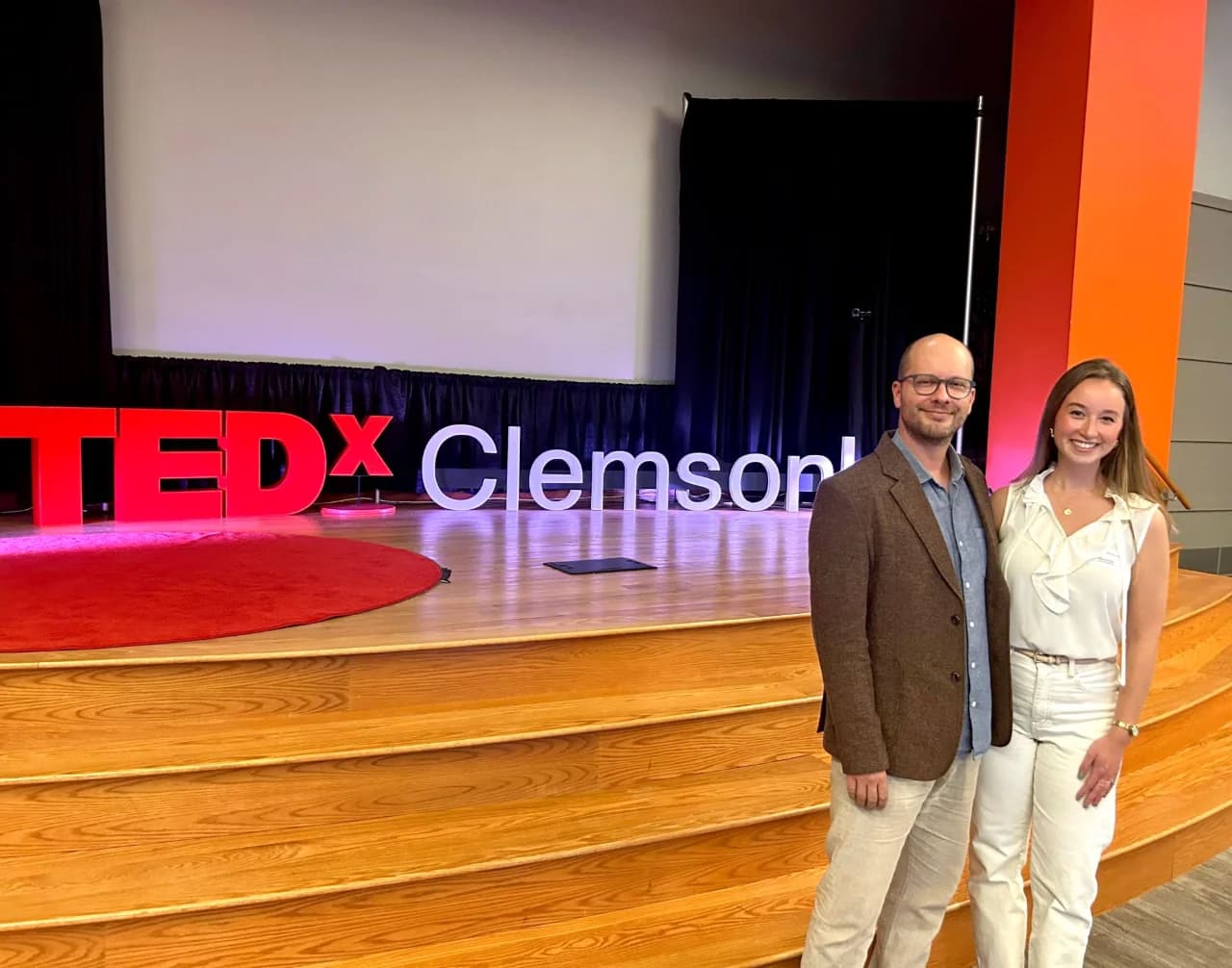
In August of 2024, Dr. Andrew Hurley—founder of The Packaging School and Professor of Packaging Science at Clemson University—took center stage at a TEDx event with the theme Innovate to Elevate.
His talk, Unveiling Packaging Truths, examined whether consumers' perceptions of the sustainability of different meal bar packaging materials aligned with the results of a modified cradle-to-grave life cycle assessment (LCA).
The findings were a result of a multi-year investigation alongside Rachel Hall—a Clemson alum who received a Masters of Science in Packaging Science in 2024 and now works as an Associate Packaging Engineer at Newell Brands.
Dr. Hurley’s analysis reveals how consumers perceive the environmental friendliness of different packaging designs and how these perceptions change when confronted with LCA data exploring the carbon emissions associated with each packaging format.
Let's dive into the details . . .
Why Meal Bars?
Dr. Hurley and Hall chose to study meal bars because approximately 45 million Americans consumed them in 2020 (Statista), generating an estimated 6 billion discarded meal bar wrappers. Despite representing a major consumer product category, meal bars have received relatively little attention in studies assessing the environmental impacts of different packaging formats.
The team also chose meal bars for their wide array of packaging materials and formats, including plastic, metal, and plant-based materials. Due to the complexity and multi-material nature of meal bar packaging formats, Dr. Hurley notes that these wrappers are often discarded incorrectly—with many going to landfills or MRFs where they may cause recycling complications.
The LCA
To evaluate the environmental impacts of different meal bar wrapper formats, the team conducted a modified cradle-to-grave life cycle assessment. The scope of the LCA included raw material extraction, production, and consumer disposal—excluding transportation / distribution of the bars to retail environments or the consumer.
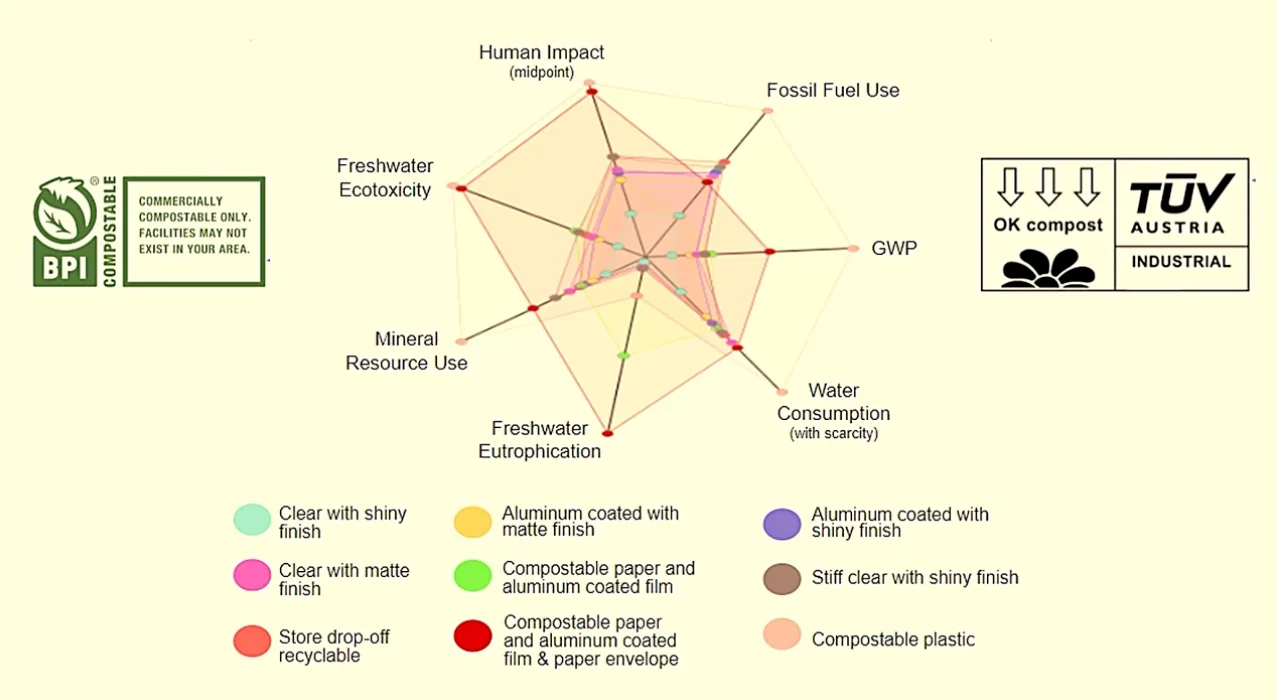
The LCA was conducted using Trayak’s COMPASS software. The emissions data was acquired through Ecoinvent, a leading life cycle inventory (LCI) database used across the globe for packaging and product LCAs.
Although LCAs can help quantify up to sixteen different environmental impact categories, the research team decided to highlight carbon emissions (global warming potential—1 kg CO2e equivalent) given the general public’s awareness of carbon emissions compared to more niche impact categories like freshwater eutrophication, ionizing radiation, etc.
The Survey
To compare the general public’s preconceived notions of meal bar wrapper formats with their opinions after reviewing emissions data, the team conducted a census-based survey of 1,027 US consumers. Participants were shown four identical, equally priced meal bars packaging in different wrapper formats.
The four wrappers included a non-recyclable plastic option, a store drop-off recyclable plastic option, a compostable paper option with aluminum film, and a compostable plastic wrapper.
The survey included a series of questions designed to assess participants’ perceptions of the environmental impact of each packaging option before and after reviewing the LCA findings.
The Results
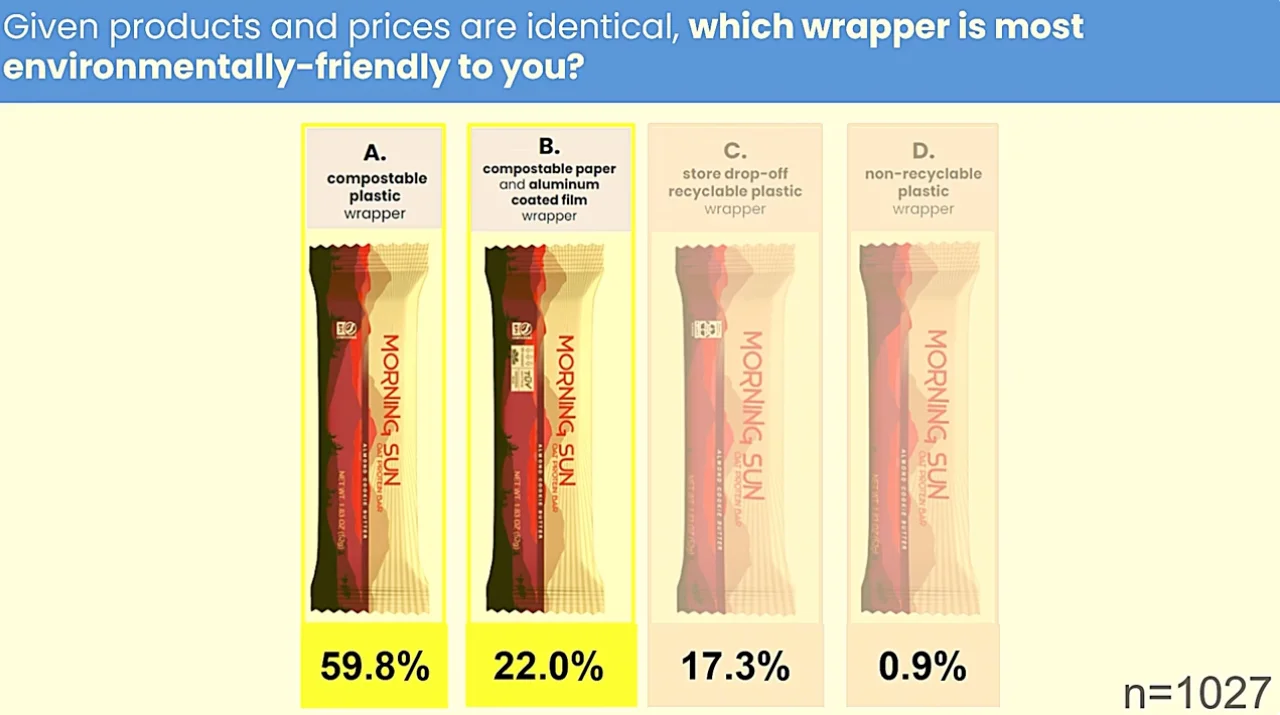
When survey participants were asked: Given products and prices are identical, which wrapper is most environmentally-friendly to you?
The results showed the following:
Compostable Plastic Wrapper: 59.8%
Compostable Paper & Aluminum Coated Film Wrapper: 22%
Store Drop-Off Recyclable Plastic Wrapper: 17.3%
Non-Recyclable Plastic Wrapper: 0.9%
This question was before survey participants were shown the emissions related to each option, and over 80% chose compostable formats based on their preconceived notions regarding material sustainability, with little love for plastic wrappers. In reality, compostable formats were found to have the highest carbon footprint of the four materials.
Dr. Hurley notes that while composting can be effective when done properly, only 0.4% of the population "reported disposing of compostable packaging at a composting facility." To explore the composting infrastructure available for packaging in the United States, check out the Sustainable Packaging Coalition (SPC) Composting Map.
Concerning the store drop-off option, the study notes that only 20% of participants were aware of store drop-off recycling programs and 13% of that 20% viewed it as the "most eco-friendly option."
As noted, the non-recyclable plastic wrapper was selected by only 0.9% of participants as the most environmentally friendly option, although it had the smallest carbon footprint.
To explore whether carbon emissions are a "socially impactful metric," the next survey question asked participants to rank the packaging options again after reviewing the carbon emissions data for each option.
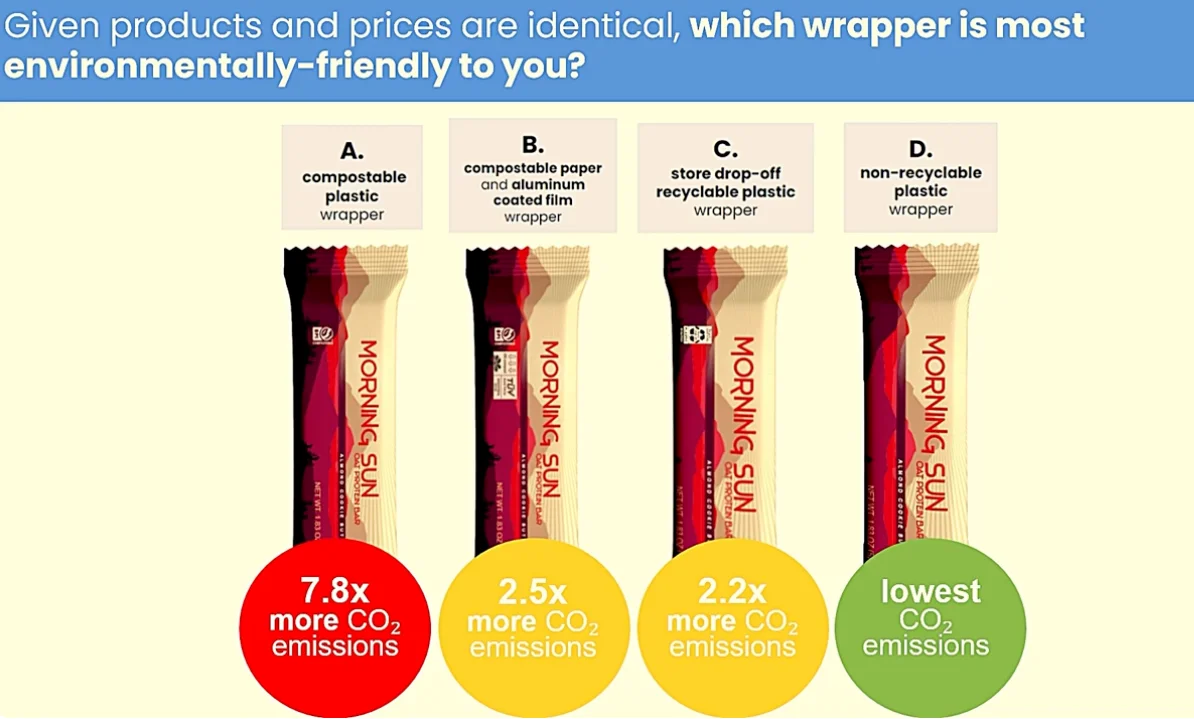
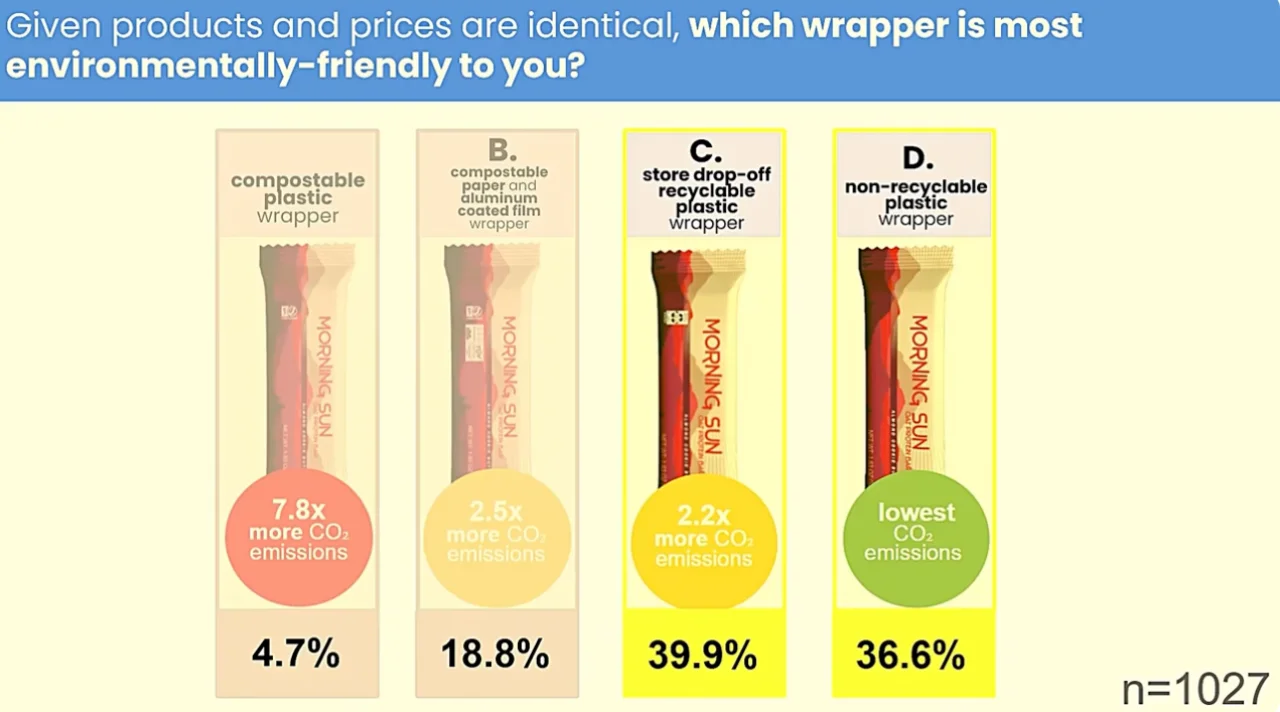
The LCA revealed substantial differences in carbon emissions among the four packaging formats:
Compostable Plastic Wrapper: 7.8x higher carbon emissions than the lowest-emissions option
Compostable Paper & Aluminum Coated Film Wrapper: 2.5x higher carbon emissions than the lowest-emissions option
Store Drop-Off Recyclable Plastic Wrapper: 2.2x higher carbon emissions than the lowest-emissions option
Non-Recyclable Plastic Wrapper: lowest carbon emissions of the four options
After reviewing the carbon emission data, participants were asked the same question again: Which wrapper is the most environmentally-friendly to you?
Compostable Plastic Wrapper: 4.7%
Compostable Paper & Aluminum Coated Film Wrapper: 18.8%
Store Drop-Off Recyclable Plastic Wrapper: 39.9%
Non-Recyclable Plastic Wrapper: 36.6%
The results revealed a dramatic shift in perception. After reviewing the carbon emissions data, participants reversed their rankings, with the wrapper initially considered the most environmentally-friendly becoming the least environmentally-friendly option.
To help visualize how carbon emissions data influenced consumer perceptions of environmentally-friendly packaging formats, Hurley and Hall represented each participant with a dot, illustrating both their initial vote and how it changed after they reviewed the emissions data.
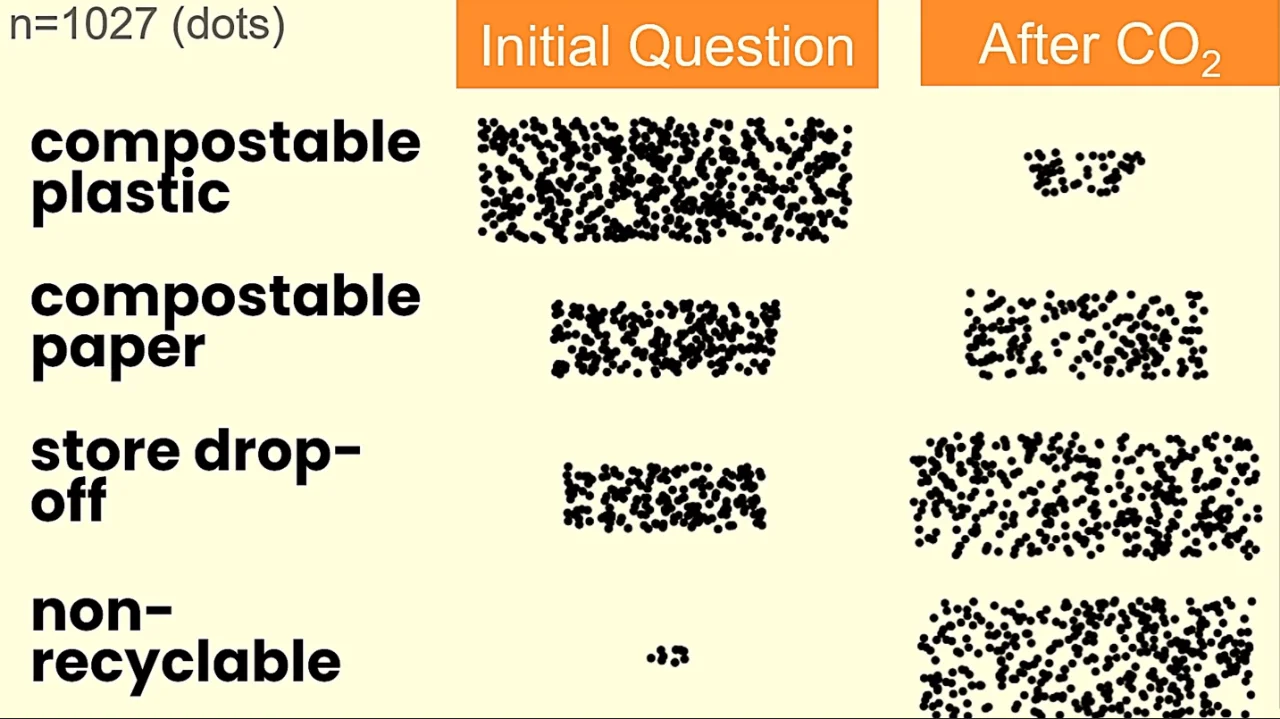
As the graphic shows, participants significantly changed their perceptions of the environmental impact of the different meal bar wrapper formats when they were presented with the carbon emissions data.
The findings also reflect the growing emphasis many companies place on reducing carbon emissions when making product and packaging decisions.
As Dr. Hurley explains:
"Lower carbon emissions don't always favor materials that are returnable, recyclable, or compostable. We asked the participants what they consider the most important, carbon emissions or ocean plastics. The majority chose carbon emissions . . . carbon is a powerful metric."
To further illustrate the differences in carbon emissions between meal bar wrapper formats, the research team represented the impacts as circles (larger ones reflecting more carbon emissions).
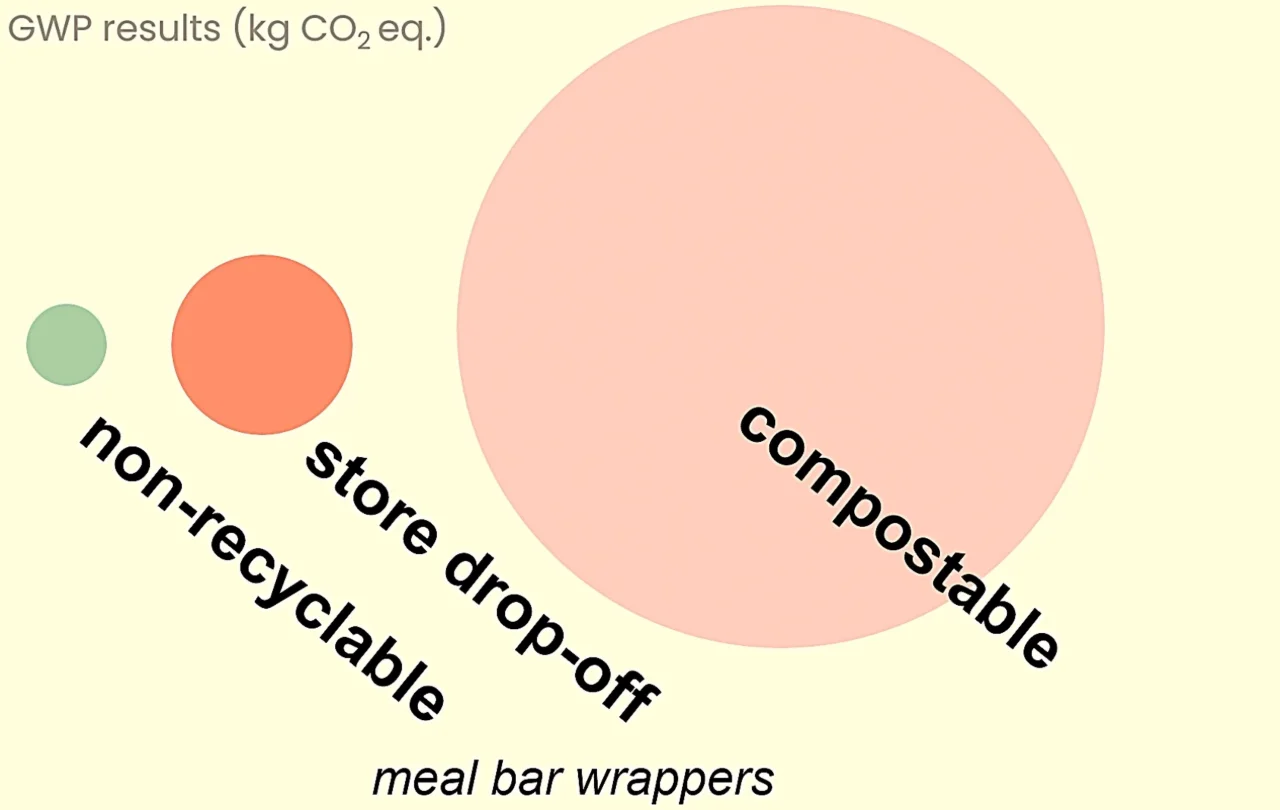
In Dr. Hurley’s words:
"The differences appear to be on a planetary scale. There is a clear distinction between a smaller footprint and a much larger one. It is easy to make a decision here if carbon emissions are the measuring stick. And this is not a new finding, many scientists have published studies showing that recyclable and compostable packaging options often have higher environmental impacts when compared to traditional polymers."
The meal bar package is just one component of impact; when adding the meal bar itself to the comparison, the results are quite staggering.
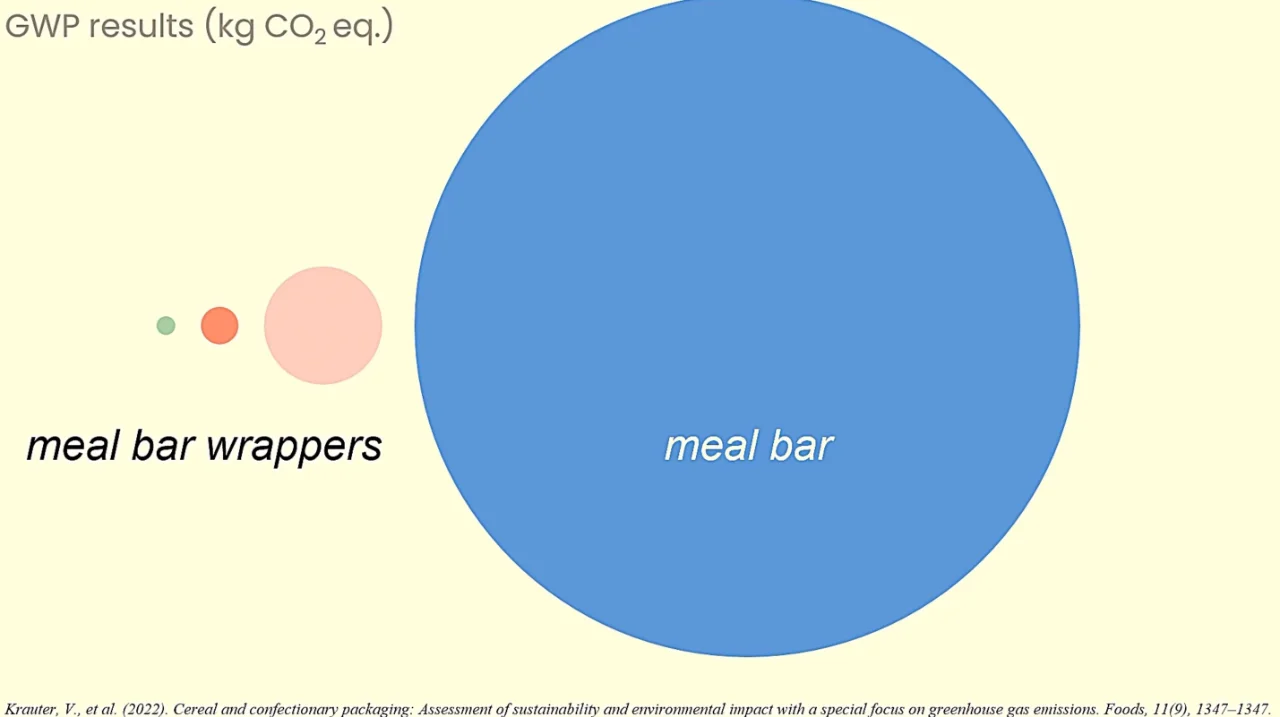
Dr. Hurley explains:
“When you place the carbon emissions of the meal bar, the food itself, you have to zoom out to fit everything on the same screen. And suddenly the differences between the packaging options don’t seem as significant."
"This prompts us to question whether carbon emissions differences between these packaging designs are practically meaningful. Perhaps we should focus more on the features and benefits the packaging systems offer—including ensuring that their end-of-life doesn’t lead to a landfill."
Moving Beyond Carbon Emissions
The research team asked participants to rank the seven different environmental impact metrics measured in the LCA for each meal bar wrapper. These were the seven impact categories available on Trayak’s COMPASS at the time of the LCA and include: resource use (fossils), carbon emissions (GWP), eutrophication potential (harm to aquatic life), resource use (minerals), particulate matter, ecotoxicity (toxic water), and water usage.
The participants responded as follows:
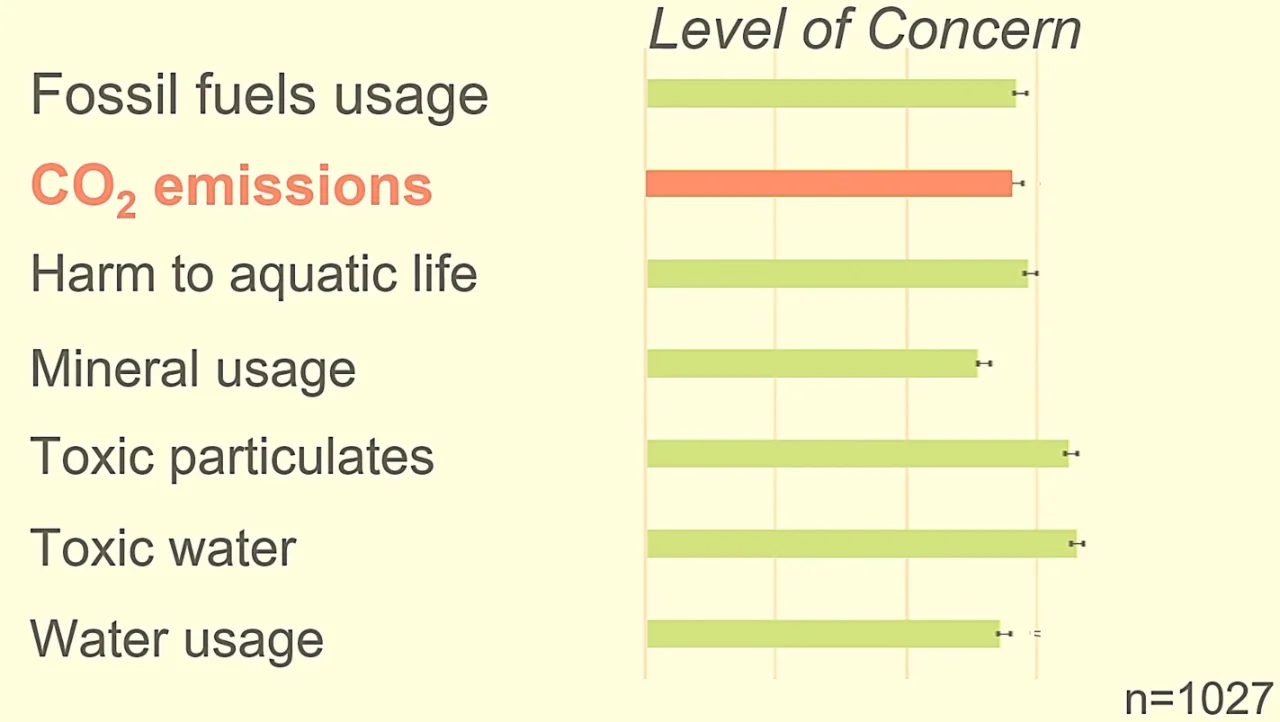
As the results indicate, participants ranked carbon emissions in the middle of the seven environmental impact categories. Toxic particulates and toxic water ranked among the highest concerns, while mineral usage and water usage ranked among the lowest.
In Dr. Hurley’s words:
"When presented with alternative perspectives on measuring environmental friendliness, carbon emissions don’t always end up on top. Interestingly we found two metrics that ranked higher than carbon emissions—water quality (toxic water) and human health (toxic particulates). These were seen as more significant indicators of environmental friendliness, yet these metrics are rarely reported or even considered in the decision making process for product and packaging development."
To end his talk, Dr. Hurley left the audience with this image:
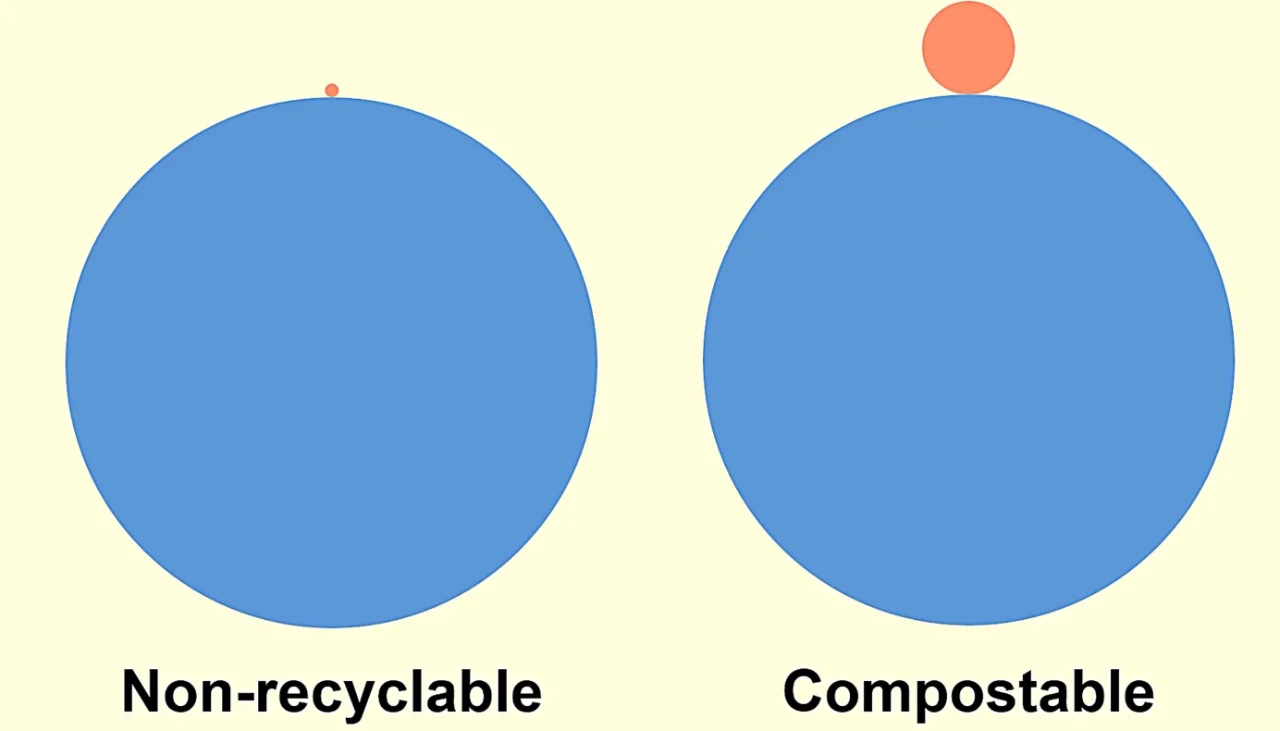
In Dr. Hurley’s words:
“These are two identical meal bars packaged in a non-recyclable and compostable wrapper. The blue circles represent the carbon emissions of the meal bar (the food itself) and both are identical. The orange circles represent the carbon emissions of the wrappers."
“Packaging makes a difference—it can create a bar with lower carbon emissions but is non-recyclable, or a bar with higher carbon emissions but is compostable. So I ask YOU, which one is best?"
“This dilemma is much larger than meal bars—brands, designers, industry, and even us as consumers have to make this decision across many of the products we select. And I hope you recognize our current methods of measuring environmental friendliness don’t always align with the materials believed to be sustainable."
"It is time to see packaging as it truly is . . . not merely a byproduct but a powerful tool that reflects our values and impacts our planet's future."
Watch the full TEDx Talk here.
Conduct Your Own Comparative Packaging LCA
Want to analyze your own product or package using the same LCA software Dr. Hurley used to evaluate meal bar packaging in his TEDx Talk?
If so, check out The Packaging School’s online, self-paced Certificate of Sustainable Packaging designed by Dr. Hurley and our team of packaging and sustainability experts.
By signing up you indicate you have read and agree to our Terms of Use. Packaging School will always respect your privacy.
