
Craft Beer Packaging with Sierra Nevada Brewing Company
Alli Keigley (Production Coordinator, Packaging School):
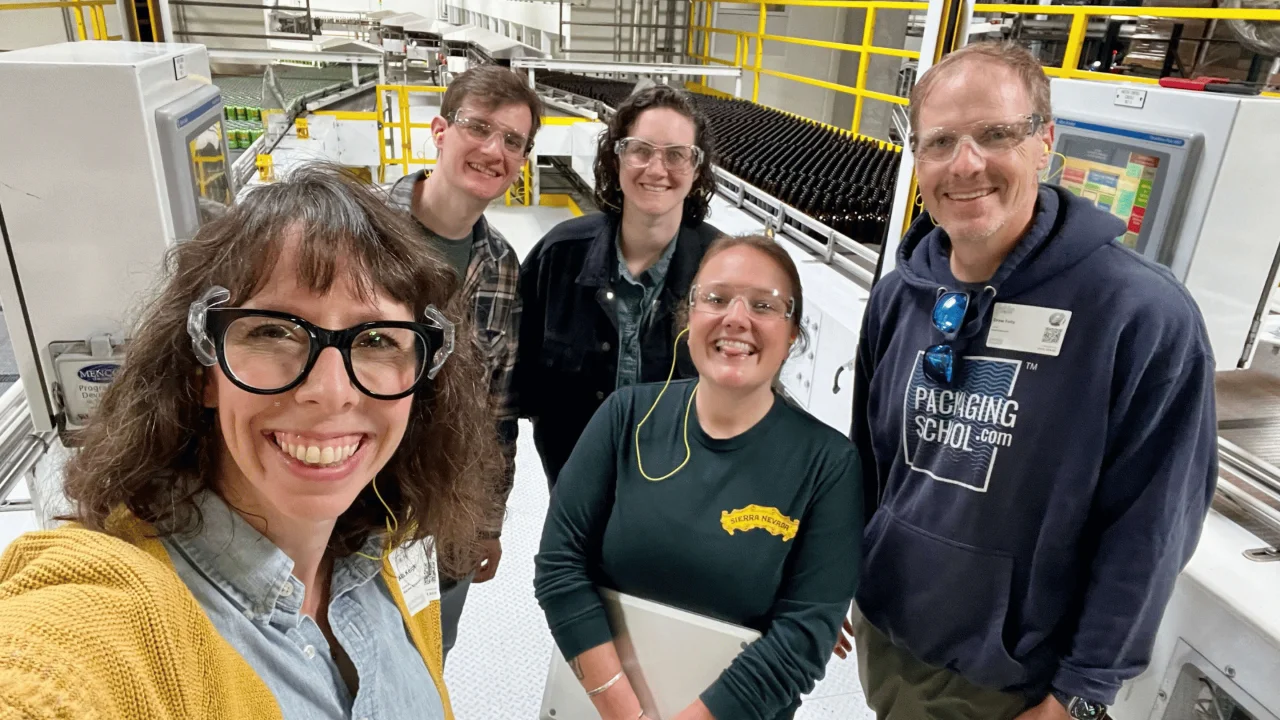
We're here at Sierra Nevada Brewing Company, their East Coast home, nestled in the foothills of the beautiful Blue Ridge Mountains. Today we're speaking with their experts about how they package many of their craft beers and getting an inside look at their packaging lines in action.
Sierra Nevada is one of the first places we visited for a packaging tour back in the early days of The Packaging School. They place a strong emphasis on sustainability, and we're excited to be back and see how their packaging operations have evolved and grown over the last decade.
Rachel Simpson (Packaging Supervisor, Sierra Nevada):
So, Sierra Nevada, “Finest Quality, Purest Ingredients,” that's our slogan, and that's on every can and bottle that we produce here. Quality is really at the forefront of everything that we do, from ingredients procurement to packaging, and it's something that we take a lot of pride in.
Ken started Sierra Nevada in 1980 on just a 10-barrel set of dairy tanks that he procured and produced himself, and it's been a labor of love since then.
So, here in Mills River we have about 25 packaging operators that operate across 3 shifts. We run 4 different lines here. We have a bottle line, a can line, a keg line, and then an automated variety line.
Brewing brews 24/7, all throughout the year. We, in packaging, we package about 24/5. So, we package anywhere from 9,000 to 15,000 barrels a week across all the lines. There are 31 gallons in a barrel. We package, on the bottle line, around 800 barrels at a time, and that's a little over a million bottles in one bottle run.
So, our can line here is a 52-head filler; we run about 685 cans a minute for 12-ounce cans. So, cans get depalletized layer by layer and go down a conveyor and then go through a twist with a pure rinse.
This is an ion-exchange pure rinse to get rid of any foreign material or anything that might cling to the can.
Cans then go into the filler, the counterpressure filler. They go into the steamer, which is a six-head steamer. They go through two points of inspection. They're checking for gross fills. They're checking for pressure variances and canted closure.
We're doing packaging checks by the lab about every 2 hours, or every 200 barrels or so, and on the bottle line, about at every hour and a half.
Brett Hetelle (Operator Mechanic, Sierra Nevada):
And if anything is not within range or not within our specs, we escalate that immediately to quality, and from there, we, you know, have an idea of what we need to do to correct the issue.
One of the main things we're looking at is our jetter. The pressure of the jetter controls how much FOB you're gonna get. FOB is foam on beer. That's that dome I was talking about on the top of the bottle. If that is not correct, then we're losing beer, if it's too much. If it's not enough on that jetter stream, then we still have oxygen in there, so you have to constantly be monitoring your jetter.
The labeler, very intense because it's running very fast. If a label is not applied to the bottle, you have very little reaction time because you have 1,000 bottles already on the line.
Thankfully, we have an inspection device after the labeler to look for those things. It's looking to make sure all 3 labels are there. It's also looking to make sure there's a crown there. So, if any of those things are missing, it will get rejected.
We're also monitoring our EBI, our empty bottle inspector. This is very important because if we see, you know, a bottle that has a critical defect, then we need to escalate and make sure there's no more on the line, and we also need to challenge that bottle multiple times through our inspection to make sure it will get rejected, and that's very important.
We have different classes of glass defects that we look at, and so, we treat those differently accordingly.
Chris Hensley (Reliability Engineer, Sierra Nevada):
Our facility only has 2 can fillers, so we can't run 6 varieties of flavors and run to our packer all at the same time. So, what we will do is we will run 1 flavor, you know, 800 barrels' worth of one flavor, and we will loose-pack it into a tray. And then we'll switch over to another flavor and run it consecutively.
So, we'll have 4 flavors for a variety pack, and then we have a—I think it's about 2 years old now—our automated variety line, where we have 4 lines, and it puts each 4 flavors on it, and it does—we have robotics, sorting, and palletizing.
Our variety line is a really high-efficiency line, and we can—I think we're reaching 500 barrels of production on the variety line every day. And I would say it would take a week's worth of time to run 500 barrels with manual rework because you have to have manual people that are opening the cartons and pulling cans or bottles out and putting them back in the right orientation. There's a lot less error, and it's a lot quicker for us to do it.
Andrew Dagnan (Sustainability Program Manager, Sierra Nevada):
We very much value quality here at Sierra Nevada, and that is one of our values along with sustainability, and so, we want to make sure we're putting out the best product at all times, obviously, but at the same time, you know, that might mean looking at things like how do we reduce water or how do we reduce CO2 and make sure that we're following the right specs and things like that to still put out the best product, both packaging, but also obviously, the beer, the liquid that's inside that packaging, while still trying to reduce those impacts as much as possible.
And sometimes those can, you know, be a little bit competing, but we want to make sure we're following both of those and having the absolute best product you can have and doing it the best way possible.
You look at a packaging, packaging operation, you have electricity, you have natural gas, you have water. So, when you think about efficiency improvements, that's a huge area that we have opportunity—CO2, carbon dioxide, as well, in a brewery packaging operation.
The other thing with packaging is that when we look at our greenhouse gas emissions, most of our emissions come outside of our four walls, and a lot of that comes from packaging. But we also have a lot of opportunity there, a lot of opportunity for both reduction, but also engaging our consumers.
So, part of our 2030 ambitions are reducing those emissions, obviously, and doing that through a way of, maybe lightweighting, maybe looking at different materials and things like that, which we're looking at right now. But we understand that it's a part of our emission scope, and we know that we need to address that.
We're really proud that we're the first business to be TRUE Zero Waste certified at a platinum level, and we put that all on all of our packaging.
If you turn around the bottom of our six-pack, you can see it right on the bottom there. It's a huge initiative inside the brewery, and we like to take that outside the brewery so that consumers can see that and hopefully be bought into what we're trying to do from a, from an environmental sustainability perspective.
Alli Keigley (Production Coordinator, Packaging School):
A big thank you to Sierra Nevada for their time and generosity in speaking with us and letting us film their packaging processes. If you want a holistic view of the packaging industry, please go to PackagingSchool.com for our full catalog of courses. And be sure to subscribe to our YouTube channel for more content like this.
By signing up you indicate you have read and agree to our Terms of Use. Packaging School will always respect your privacy.
