
Unpacking Color Theory: The Munsell Color Model
Nick Riedl (Packaging School's Creative Lead)
Color—what would design be without color? It's one of the first things the human eye detects, so its importance in design cannot be overstated. But even though we can spot it and point it out, we probably don't always understand the science or reasoning behind it.
One could spend a lifetime dedicated to the study of color, but we wanted to give you just a little taste today of how understanding color theory can help your next design.
John Seymour ("The Math Guy") is an applied mathematician and color scientist who has spent decades finding creative solutions to problems that lie at the intersection of engineering, physics, computer science, and math.
We sat down with John so he could share some of his color science wisdom with us. In this particular video, we’ll hear why organizing color can be so difficult, but how a solution lies in something called the Munsell Color Model.
Learning Objectives:
By the end of this short lesson you’re going to be able to:
Explain why color is three-dimensional
Describe how hue, value, and chroma together define a color
And summarize the Munsell Color Model
John Seymour (Color Expert)
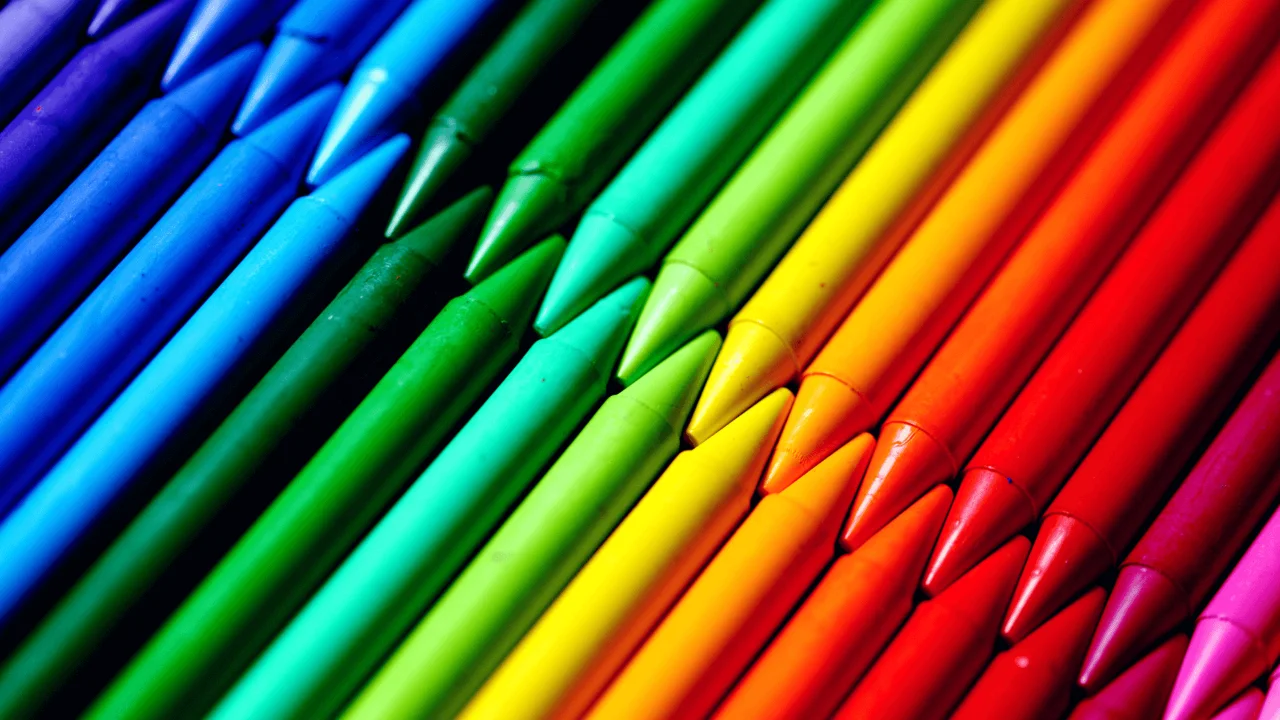
Don't you just love crayons? I mean, you get the box, the big box, really.
I've got another 120-box at home that I try to keep under lock and key. So, how do you organize your crayons?
We can think about ROY G BIV. Remember that? That came along someplace in elementary school—red, orange, yellow, green, blue, indigo, violet. And we line up those crayons in that order, or flip the order around either way, and it feels good.
Anybody who is not colorblind can look at those crayons and say whether or not they are in the correct order. And we can add more crayons to this. But then there's some crayons that don't fit—like white, black, and gray. And then there's other colors that . . . brown—brown isn't in the rainbow.
Why is it that we say all the colors in the rainbow when pink is not in the rainbow? Magenta is not in the rainbow.
The point is that if I lay out my crayons like this in rainbow order, then white, black, and gray have no place to fit. But I can take those three colors. I can take white, gray and black, and I can put those in order and they feel nice.
Yellow would feel good if I put it on one side toward the white. And if I had dark blue, a navy blue, that would feel good next to the blue. But it's not nice order. It doesn't fit in that order.
And I could take white, pink, and red and put those in an array and they would feel good together. I could add brick red and black. And now I have a line of five colors that are all nicely in order, but I don't have all my crayons there.
The thing is that there's no way to take this whole box of crayons and arrange them in a line that makes sense to everybody—that feels good.
Color is not one-dimensional. Color is three-dimensional.
The Role of the Munsell Color Model
There was a fellow by the name of Albert Munsell. He lived about 1858 to 1918. He developed a color system. The color system had all of the colors arranged in three dimensions. And he had three dimensions, three attributes, that any color, any color would have those three attributes—hue, value, and chroma. And those three attributes would uniquely define any color.
The hue—you see it's a circle here; the hue comes around. We have 10 different steps of hue that he defined—red, reddish purple, purple, purple blue, blue, bluish purple, I would call it cyan, green, greenish yellow, yellow, and yellow red, which I would call orange.
Each one of those he's divided into 10 different groups. So, there's five R, six R, seven R . . . there's a hundred different hues that he has. And any color you can define what its hue is, well, I should say any color except white, gray, and black.
Second attribute that he has is value, which is, we might call it intensity or lightness. White at one end with a value of 10; black at the other end with a value of zero—and all the different values in between.
And any of the crayons, like the yellow crayon, I said, fits better with the white. So, that would maybe be an eight or a nine. And the navy blue fits better with black. So, it has a lower value, maybe two or three.
Third attribute is chroma—that might be called the richness, the intensity of the color, although that's a confusing word. Saturation of the color—that's another good name for it. And it is the difference between the color and an equivalent gray—a gray of the same lightness.
So, we see here a scale of chroma going from gray out to a good, solid rich red. We can combine those together. Here, I've combined two of those attributes to make this triangular-shaped plate.
Value goes up and down; and off to the side, we have chroma. And we see all the different combinations of them together. And this is for red.
We would have one of these plates for each of the 10 or 100 different colors that we have in the Munsell Color Tree.
Here we see the Munsell Color Model being modeled by the Munsell Color Model model, or my wife. This is a tree that has all these different plates in it. Well, it's got 10 of them, and it organizes, it shows us how to take any of the crayons that we want to look at, and we can say, I know where this crayon belongs. I can uniquely identify where this color belongs.
Nick Riedl
Pretty fascinating, isn’t it? The Munsell Color Model demonstrates that color is actually 3-dimensional and can be accurately identified and placed in sequence with a clear understanding of its hue, value, and chroma.
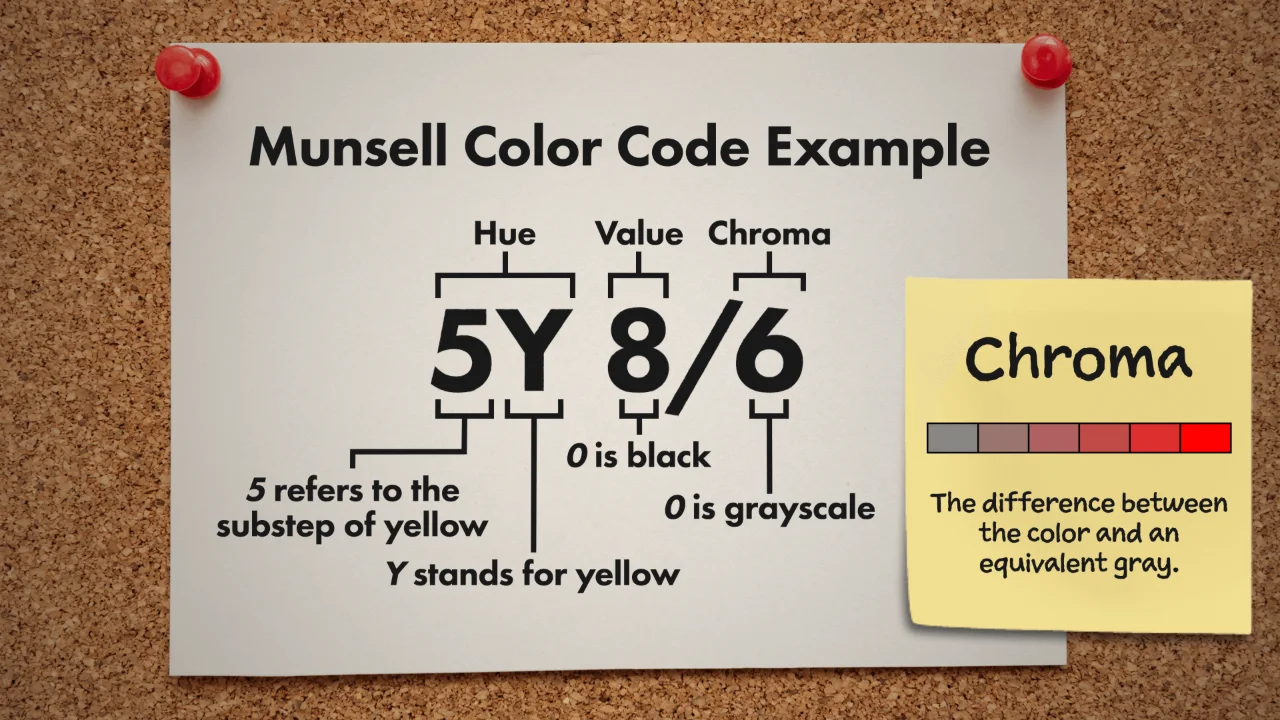
With the Munsell Color Model, colors are identified not by name, but by a code that might look something like this. Here, 5Y represents the hue. Y stands for yellow, while 5 represents the sub-step of yellow being referenced. Each principal and intermediate color mentioned on the wheel John showed us earlier has 10 sub-steps or “variations.”
The 8 represents the value, or how light or dark the color is. A value of 0 results in the color black, and the farther away from 0 you get, the lighter the color is.
6 represents the chroma. As John said, chroma is essentially the intensity or vibrance of the color. A chroma of 0 results only in grayscale colors. As the number increases, the chroma moves further away from gray and more inline with the hue color.
One of the major benefits of the Munsell Color Model is the precision in which colors can be identified and replicated. The model also gives a nice palette of options once you’ve selected a primary color. But this is just the tip of the iceberg when it comes to color theory, so let us know if you’d like to see a continued exploration of this topic.
In the meantime, be sure to subscribe to The Packaging School on YouTube!
Learn More About Color in Our Certificate of Packaging Science (CPS)
Interested in learning more about the role of color science in packaging design?
Our online Certificate of Packaging Science (CPS) program includes 12 courses that dive into the art, science, and business of packaging design.
Learn more about the program here.
By signing up you indicate you have read and agree to our Terms of Use. Packaging School will always respect your privacy.
