
The EU Deforestation Regulation (EUDR): What Packaging Professionals Need to Know
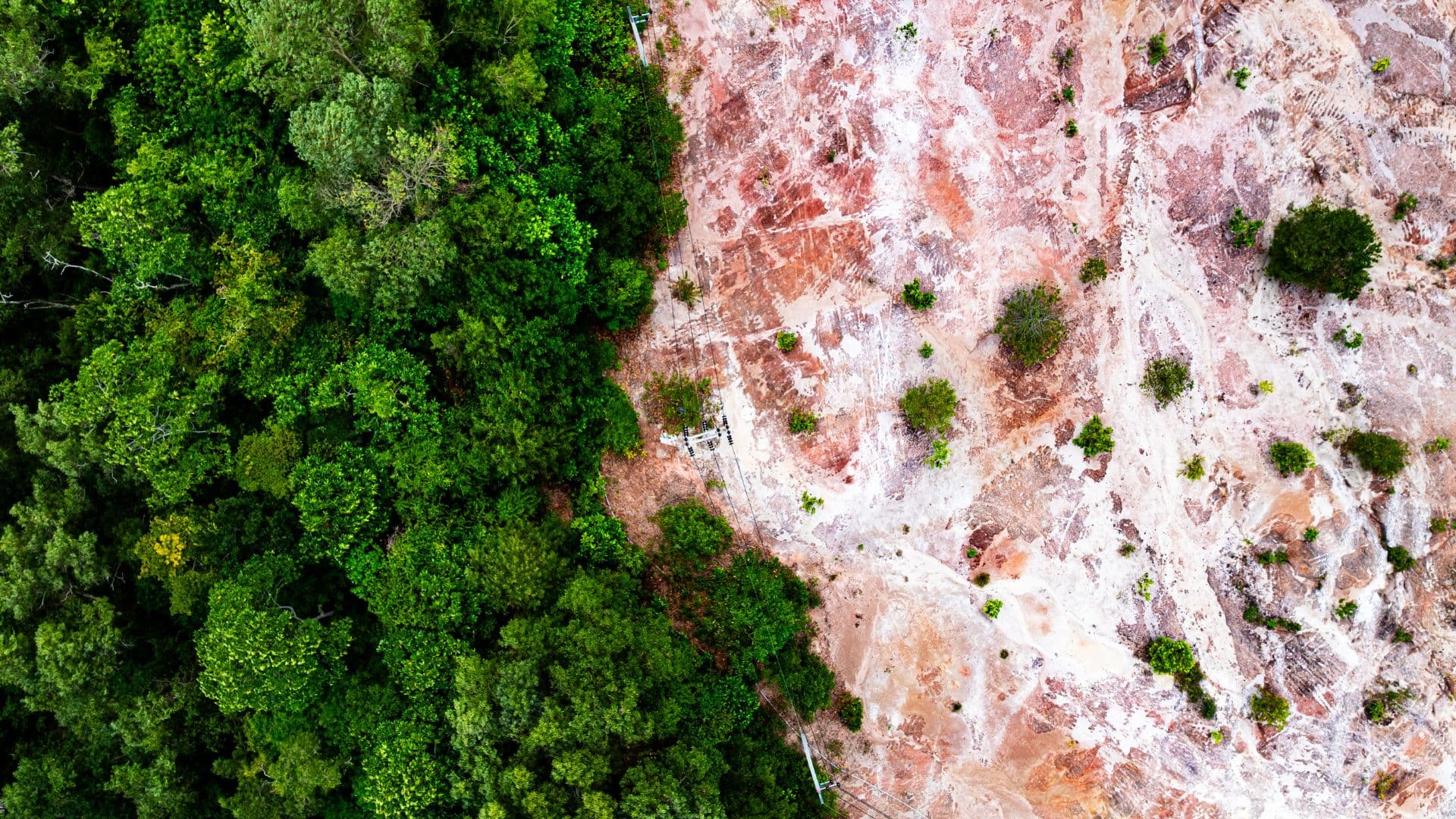
The term “environmental impact” can conjure up many different images in our minds—melting ice caps, plastic pollution in the ocean, or biodiversity loss due to industrial land use. One of the most far-reaching anthropogenic impacts, with consequences for ecosystems, climate change, and communities alike, is deforestation.
Deforestation is a plight that impacts virtually every corner of the globe. Our World in Data highlights that since the last ice age (about 10,000 years ago) the earth has lost 1/3 of its total forests. To put this loss in numbers, this represents nearly 2 billion hectares of forests, an area two times the size of the United States.
Of the 2 billion hectares lost in the last 10,000 years, 1.5 billion hectares were lost in just the last 300 years, largely driven by agriculture, infrastructure development, and commodity sourcing. Today, the UN FAO projects that 10 million hectares of forests are cut down annually—an amount equivalent to the size of South Korea.
Yes, you read that correctly . . . the world loses forested areas about the size of South Korea each and every year. And this is despite an increase in awareness, activism, and voluntary certification systems to curb deforestation over the last few decades.
Deforestation not only impacts the 80% of the world’s land-based species that live in and among forests (animals, plants, fungi, and insects) but also has far-reaching effects on humans and the acceleration of climate change.
Global forests provide countless ecosystem services and natural capital that all humans rely on, including but not limited to:
Storing 3/4 of the world’s fresh water (accessible)
Key raw materials and commodities for many sectors
Essential raw materials for countless medicines
Flood buffering and filtration to avoid run-off and impact of natural disasters
Places for recreation and spiritual retreat
Beyond the services society benefits from, protecting and preserving forests is a key lever in slowing the impacts of anthropogenic climate change. Forests around the world, both temperate and tropical, are incredible "carbon sinks."
The World Resources Institute (WRI) notes that forests absorb twice as much carbon as they emit annually. To put it in numbers, the WRI states that forests absorb 7.6 billion metric tons of carbon dioxide annually, which equates to 1.5 times more carbon dioxide than the United States emits annually. Tropical forests, like the Amazon and Congo, hold 1/3 the amount of carbon dioxide that is held in the atmosphere—30% of which is in forests in South America (WWF UK).
When forests are torn down to meet the needs of industry and development, they no longer absorb carbon dioxide from the atmosphere; rather they release copious amounts of carbon as they decompose.
Deforestation is a global problem, requiring interdisciplinary approaches to help limit it. This is due to the fact that there are many interlinked drivers of global deforestation, including but not limited to:
Permanent land use change for beef, soy, and palm oil production—particularly in Brazil and Indonesia
Trees harvested for timber, paper, packaging, and other uses
Permanent land use change for industrial-scale agriculture
Permanent land use change for development and infrastructure
Land use change for mining and industrial activities
While the plight of deforestation feels daunting, some governments—such as the European Union—have worked to limit the import and export of commodities tied to deforestation by imposing compliance obligations on the private sector.
One example of this approach is the European Union’s Regulation on Deforestation-Free Products (EUDR), which creates due diligence and supply chain transparency standards for the seven commodities with the greatest impact on deforestation around the globe.
The rest of this article will provide an overview of the EUDR and a case study for how it applies to sourcing practices related to the paper packaging industry.
Intro to the EU’s Regulation on Deforestation-Free Products

Beyond voluntary, market-based certification and labeling schemes (e.g., the Sustainable Forestry Initiative (SFI) program), the European Union has adopted a mandatory, policy-based approach to tackle deforestation—the Regulation on Deforestation-Free Products (EUDR).
The EUDR initially passed in June of 2023 and was supposed to come into force for medium and large organizations on December 30, 2024 and for small / micro organizations (less than 50 employees and 10 million euros in annual revenue) on June 30, 2025. The implementation of the law has been delayed by the EU twice, with the first delay in December 2024.
The latest effective dates are:
Medium and Large Organizations: December 30, 2026
Small and Micro Organizations: June 30, 2027
As with all policies, stay tuned for updates and delays related to key implementation dates for the EUDR here.
The EUDR seeks to limit (and ultimately eliminate) deforestation tied to the import and export of seven commodities, including:
Cocoa
Coffee
Cattle
Palm Oil
Rubber
Soy
Wood
The focus on these seven commodities stems from the EU’s view that they are key drivers of deforestation worldwide. The EU leverages the EUDR to ensure EU nations and organizations do not contribute to forest degradation through the sourcing of these commodities and the sale of their related products.
In the EUDR, any entity (operator or trader) who places one of the seven commodities on the EU market (or exports from it) has to comply with mandatory reporting requirements to ensure products do not originate from recently deforested land plots or contribute to forest degradation.
In order to achieve this, the EUDR has a three-pronged approach to due diligence wherein companies must:
Collect relevant information including the geolocation of all areas of production
Conduct a risk assessment based on the information collected
Mitigate and manage the risk(s) if a non-negligible risk is identified
Recognizing that each country has a different level of risk when it comes to producing commodities tied to deforestation, the EUDR leverages a benchmarking system to classify nations as: Low Risk, Standard Risk, or High Risk. The level of perceived risk in the EUDR determines the level of due diligence and reporting to be performed by EU operators and traders.
Aside from limiting deforestation through due diligence requirements for organizations, the EU is aware of the interrelated impacts of reducing deforestation, including controlling greenhouse gas emissions and protecting biodiversity hotspots.
In the words of the European Commission:
“By boosting consumption of ‘deforestation-free’ products and reducing the EU’s impact on global deforestation and forest degradation, the new regulation aims to bring down greenhouse gas emissions and biodiversity loss.”
The EUDR is a part of a larger EU initiative to limit environmental impacts of industry and fight climate change. Similar programs include but are not limited to:
The European Commission defines the three objectives of the EUDR as:
Ensuring the listed products EU members buy, use, and consume do not contribute to deforestation and forest degradation in the EU and globally
Reducing carbon emissions caused by EU consumption and production of the relevant commodities by at least 32 million metric tons each year
Addressing all deforestation driven by agricultural expansion to produce the commodities in the scope of the regulations, as well as forest degradation
In order to understand what compliance looks like in the EUDR, it is essential to understand the difference between operators and traders.
The remainder of this article will explore the difference between operators and traders, the current status of country classification, and a packaging industry-related case study of EUDR compliance in action.
How the EUDR Works: Operator vs. Trader
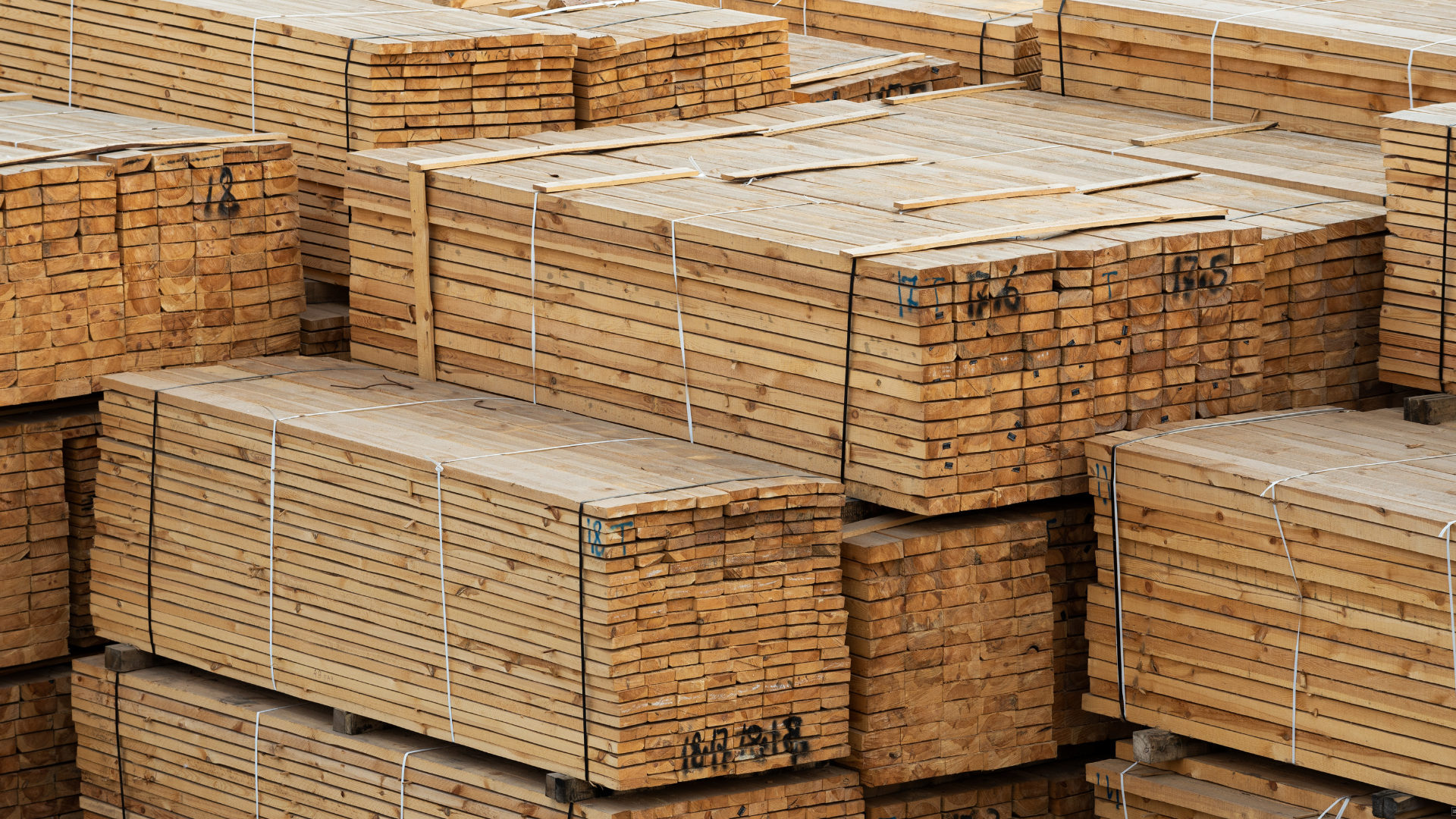
In order to help EU organizations understand the EUDR and how it applies to their individual operations, the EUDR splits compliance responsibilities into two types of entities—operators and traders.
An operator is “any natural or legal person who, in the course of a commercial activity, places relevant products on the market or exports them.”
For example, a Belgian pallet manufacturer imports wood from Canada to convert into pallets and places them on the EU market for the first time (by selling to a distributor). Since the pallet manufacturer is the first entity to place the commodity on the EU market, they are responsible for submitting a due diligence statement, recording geolocation data, and assessing risks.
A trader is “any person in the supply chain other than the operator who, in the course of a commercial activity, makes relevant products available on the market.”
For example, a German packaging distributor buys pallets from the Belgian pallet manufacturer to resell to the EU automotive market. Since the pallet manufacturer already conducted due diligence when importing the commodity, the trader is only responsible for tracking the parties from whom they purchased the pallets and to whom they sell them.
Operators carry the compliance burden (due diligence, data collection, and risk management) while traders carry the traceability burden (tracking whom they buy commodities from and whom they sell them to).
In the EUDR, the onus of compliance always falls on whoever first places the commodity on the EU market; in this case, the Belgian pallet manufacturer.
It is important to note that different operator and trader obligations exist for micro and small enterprises—learn more here.
How the EUDR Works: Country Risk Classification
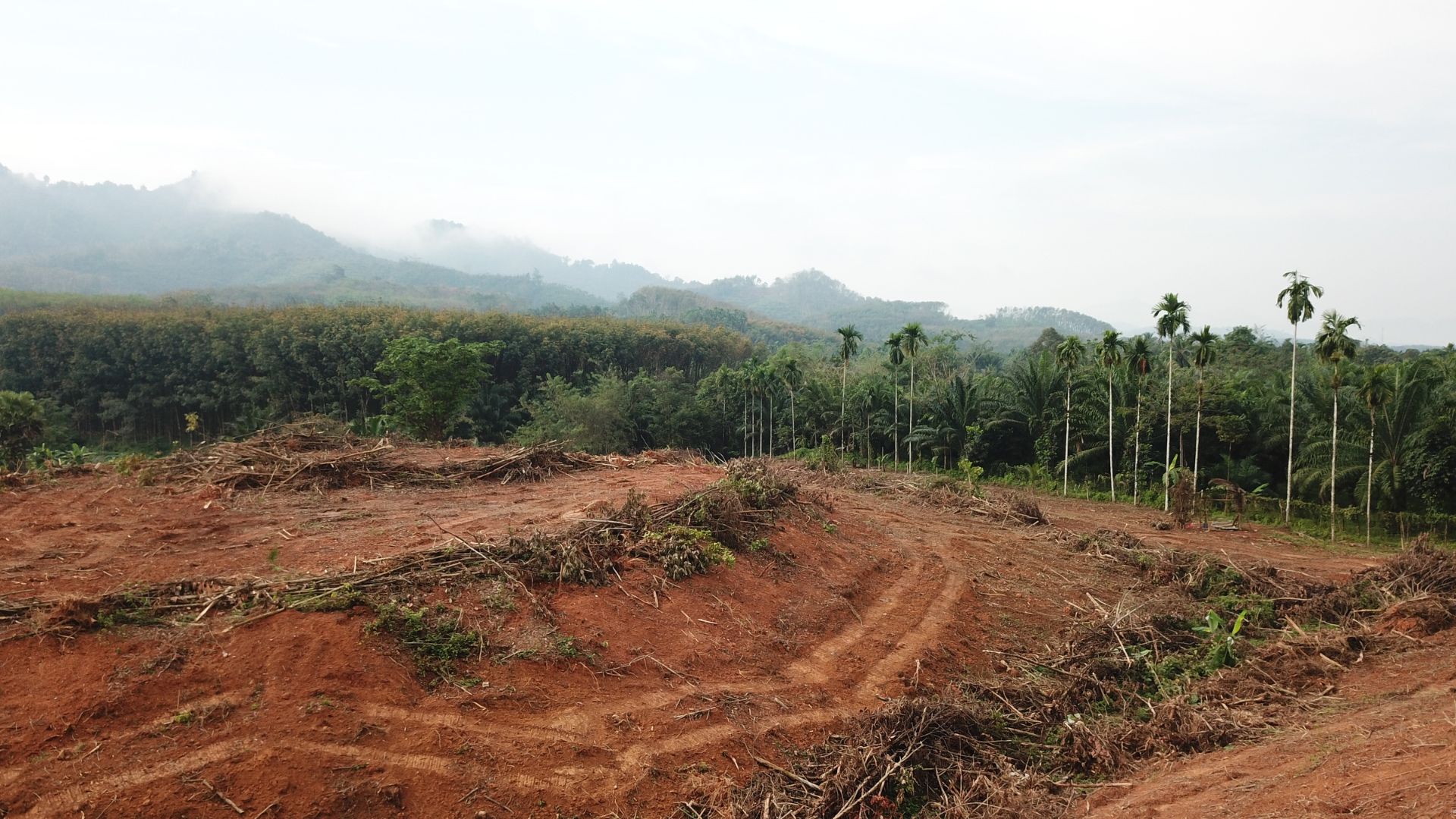
The European Commission uses a benchmarking system to ensure implementation of the EUDR is effective and streamlined. The system ranks countries—both inside and outside of the EU—by the perceived level of risk in producing commodities tied to deforestation and forest degradation. The purpose is to help the EU focus on extra due diligence where it is needed most.
As stated earlier, the three levels of risk in the current benchmarking system are: Low Risk, Standard Risk, and High Risk.
Sourcing covered commodities from a low risk nation, like the United States or Canada, calls for simplified due diligence obligations and fewer checks by EU authorities.
Operators who source from a high risk nation, like Russia or Myanmar, are subject to enhanced due diligence obligations and more frequent checks by EU authorities.
The map below shows the current status of EUDR country classification defined by the European Commission:
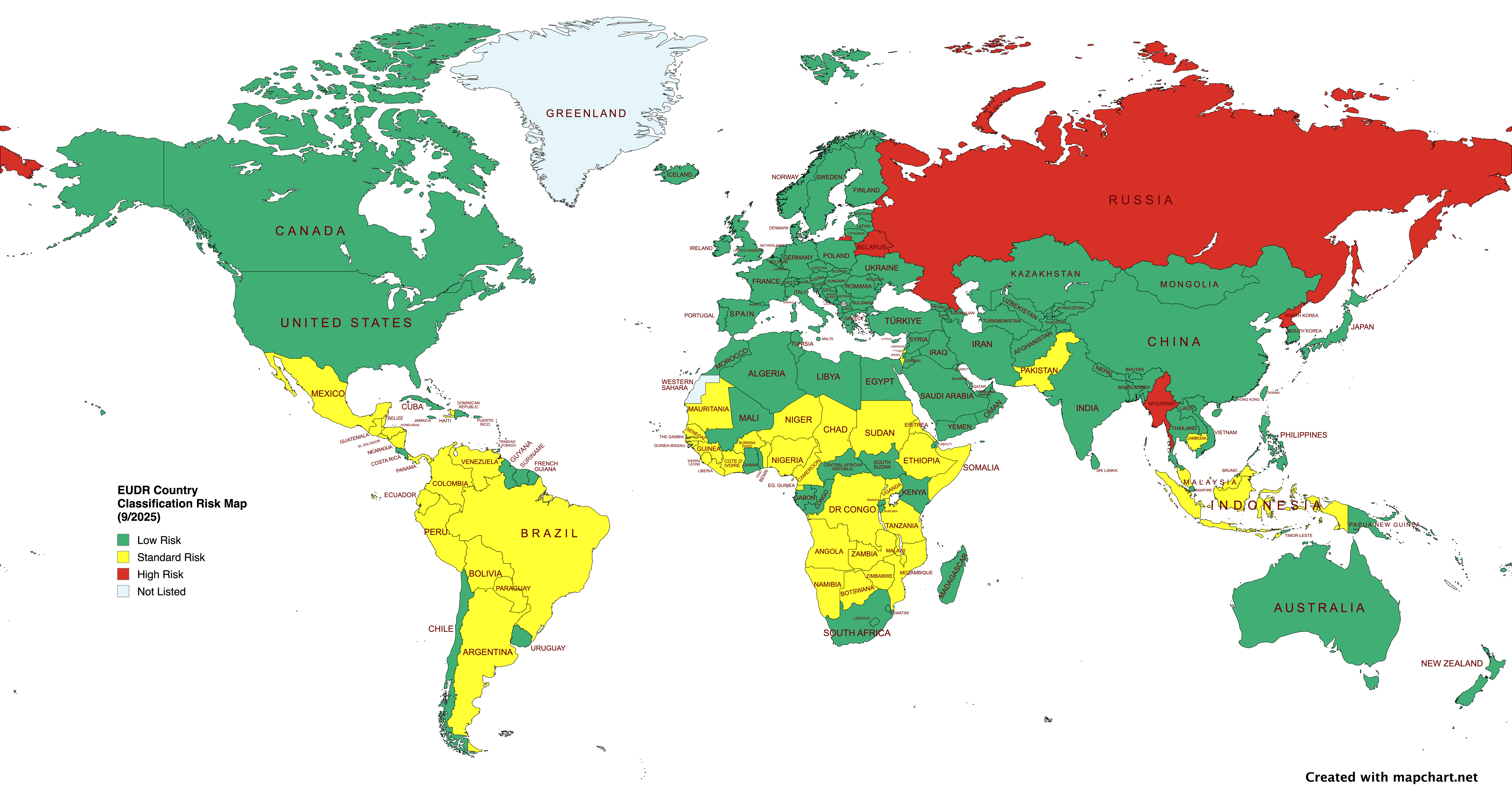
The current classification is based on data from the Global Forest Resources Assessment dataset by the Food and Agriculture Organization of the United Nations (FAO FRA).
The benchmarking system is dynamic and subject to review in 2026 and beyond. Meaning a country, like Brazil, could shift from standard to low risk if EU authorities feel measures have been implemented that reduce the risk of producing commodities contributing to deforestation.
How the EUDR Works: Packaging-Related Commodities & Products
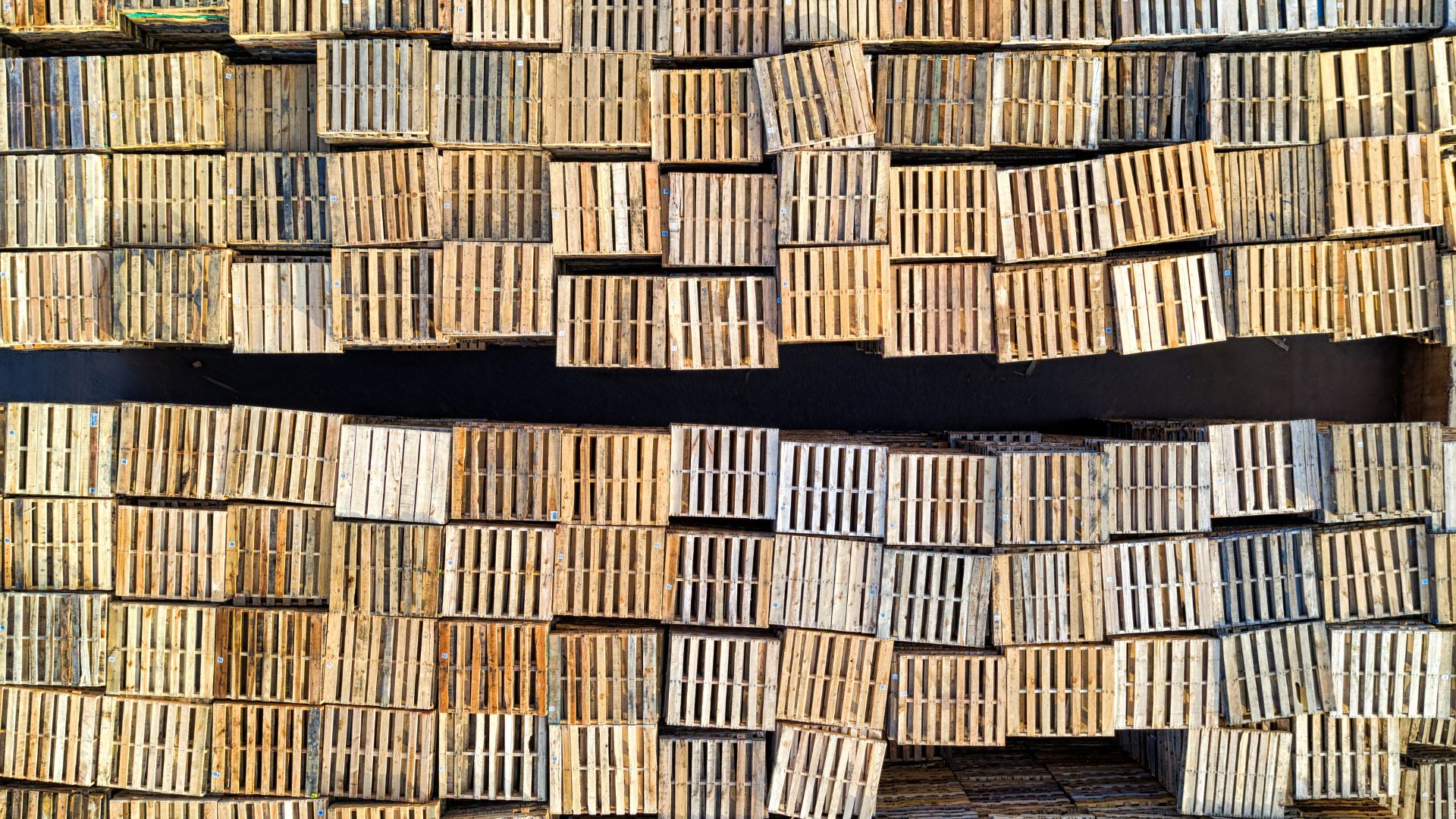
While the EUDR is primarily focused on agricultural commodities, the inclusion of wood as one of the seven covered commodities brings the packaging industry into the world of EUDR compliance.
Annex I—“Relevant Commodities and Relevant Products”—of the EUDR defines which wood-based packaging products are compliant, including:
4410: Particle board, oriented strand board (OSB) and similar board (e.g., waferboard) or wood or other igneous materials, whether or not agglomerated with resins or other organic binding substances
4411: Fiberboard of wood and other ligneous materials, whether or not bonded with resins or other organic substances
4415: Packing cases, boxes, crates, drums and similar packagings, of wood; cable-drums of wood: pallets, box pallets and other load boards, of wood; pallet collars of wood (not including packing material used exclusively as packaging material to support, protect or carry another product placed on the market)
4416: Casks, barrels, vats, tubs and other coopers’ products and parts thereof, of wood, including staves
4421: Other Articles of Wood – Pulp and Paper of Chapters 47 and 48 of the Combined Nomenclature, with the exception of bamboo-based and recovered (waste and scrap) products
It is essential to understand which types of wood-based packaging are compliant under the EUDR; the quote below (part of 4415) defines the distinction between packaging that is EUDR compliant and not, stating:
“Not including packaging materials used exclusively as packaging material to support, protect or carry another product placed on the market.”
In other words, if you are an EU-based organization looking to import small wooden boxes to ship finished goods to the consumer, this would not be covered by the EUDR.
For example, a German chocolate brand imports small wooden boxes from China for its product packaging to protect the product during shipping—this would not fall under EUDR compliance.
However, if you are an EU equivalent to ULINE importing wood to convert into industrial packaging materials to sell to others (traders) for moving automotive parts and unfinished goods throughout the EU, then your imports would be covered by the EUDR.
For example, a French packaging supplies company (operator) imports wood that will be converted into wooden pallets and sold to BMW Germany (trader) to facilitate the movement of automotive parts throughout BMW’s supply chain. This would fall under EUDR compliance obligations.
Another way to think about it (with some stipulations) is:
Consumer / Product Packaging = not covered
Industrial / B2B Packaging = covered
Before the EUDR is fully implemented, The Packaging School recommends understanding the role your organization plays in your value chains when it comes to wood and paper-based packaging.
Are you an operator or trader in an industrial packaging supply chain? If so, do you know what compliance looks like? Or perhaps you only work with consumer / product packaging and, therefore, do not need to plan ahead.
Regardless, getting organized now before the 2026 and 2027 implementation dates is key to success and fewer late nights.
How the EUDR Works: Explorative Packaging Industry Case Study
To better understand how EUDR compliance requirements impact both EU operators, traders, and other organizations, let’s look at an illustrative case study of EUDR in action.
SCENARIO: A Belgian pallet manufacturer (BPM Inc.) sources wood from a tree farm in northwestern Canada to convert into pallets and sell to distributors (place on the EU market). BPM Inc. sells pallets to a German packaging distributor (GPD Inc.), which resells them to BMW Germany.
STEP 1: BPM Inc. imports into the EU and places pallets on the EU market
BPM Inc. plays the role of the operator, as they are the first company to import the commodity (wood) and place it on the EU market (in the form of pallets).
As an operator, BPM Inc. is responsible for conducting due diligence and submitting a due diligence statement, collecting geolocation data, and assessing deforestation risks.
Since Canada is currently classified as a low risk country, BPM Inc. has simplified compliance obligations.
STEP 2: GPD Inc. buys pallets from BPM Inc. to resell to automotive market
GPD Inc. plays the role of the trader, as they resell pallets but are not the first to place the commodity on the EU market.
Since BPM Inc. has already fulfilled operator responsibilities, GPD Inc.’s EUDR obligations are simplified.
GPD Inc. must keep record of who they purchased the pallets from (BPM Inc.) and who they sold them to (BMW Germany).
STEP 3: BMW Germany buys pallets from GPD Inc. for use in internal supply chain
BMW Germany has no compliance obligations as long as they use the pallets internally.
GPD Inc., as a trader, only has to keep record of who they bought the pallets from initially (BPM Inc.) and who they resold the pallets to (BMW Germany).
If BMW Germany decides to resell the pallets at a later date, they would have to play the role of a trader and record who they bought the pallets from (GPD Inc.) and who they resell the pallets to (e.g., Renault).
Overall, the first company to place a one of the seven commodities on the EU market assumes the role of the operator and is responsible for conducting due diligence and meeting the core compliance requirements under the EUDR.
Subsequent companies that resell the product without being the initial importer act as traders and face more limited, primarily recordkeeping-focused obligations. Downstream companies using the product internally have no obligations unless they reintroduce it to the market, at which point trader responsibilities apply.
EUDR Prep Homework: Learn packaging science
One of the best ways to prepare for EUDR compliance obligations (and other packaging-related laws) is to learn the language of packaging science.
A comprehensive understanding of packaging materials, formats, and systems will serve as your guiding compass to navigate a sea of regulatory uncertainty.
Our online Certificate of Packaging Science (CPS) program was designed by Dr. Andrew Hurley, founder of The Packaging School and the Director of Packaging Science at Clemson University. Through 12 online courses spanning 60 hours of content, the CPS is designed to upgrade your packaging IQ on your terms.
Interested in seeing if the program is a good fit for you? Set up a 15-minute demo call with our Academic Director—Dr. Julie Rice Suggs—here.
By signing up you indicate you have read and agree to our Terms of Use. Packaging School will always respect your privacy.
