
Texas' Food Packaging Labeling Law (SB 25): A Packaging Professional's Guide to Compliance

Texas, led by Governor Greg Abbott, recently made major moves to regulate ingredients, food dyes, and other additives in food products sold in the state—a strong move with the potential to shake up the food, packaging, and labeling industries in the US and beyond.
The Facts
On June 22, 2025, Governor Greg Abbott signed SB 25 into state law; the bill is officially titled “An act relating to health and nutrition standards to promote healthy living, including requirements for food labeling, primary and secondary education, higher education, and continuing education for health care professionals; authorizing a civil penalty.”
SB 25 is a bipartisan bill requiring warning labels on food packaging and other products containing one or more of 44 ingredients and additives that are restricted, require warning labels, or are otherwise regulated in Australia, the European Union, UK, and Canada—regions that have maintained stricter food safety and labeling requirements for decades.
Should companies decide to operate as normal and not change their recipes by January 1, 2027, a label must be added to the packaging stating: “WARNING: This product contains an ingredient that is not recommended for human consumption by the appropriate authority in Australia, Canada, the European Union, or the United Kingdom.”
The law also establishes three requirements for how the warning must appear on pack. It must:
“Be printed in a font size not smaller than the smallest font used to disclose other consumer information required by the FDA.”
“Be placed in a prominent and reasonably visible location.”
“Have sufficiently high contrast with the immediate background to ensure the warning is likely to be seen and understood by the ordinary individual under customary conditions of purchase and use.”
Manufacturers operating in Texas that fail to comply with this act could face fines of up to $50,000 USD per day for each food product in violation of SB 25, along with other legal consequences.
Under the legislative timeline, beginning January 1, 2027, the warning label above will apply to labels “developed or copyrighted” on or after that date.
What Warrants the Label?
At this point, you might be wondering what ingredients and additives are part of SB 25.
The bill states:
“A food manufacturer shall ensure each food product the manufacturer offers for sale in the state includes a warning label disclosing the use of any of the following ingredients, if the United States Food & Drug Administration (FDA) requires the ingredient to be named on a food label and the ingredient is used in a product intended for human consumption:”
The 44 ingredients in question include:
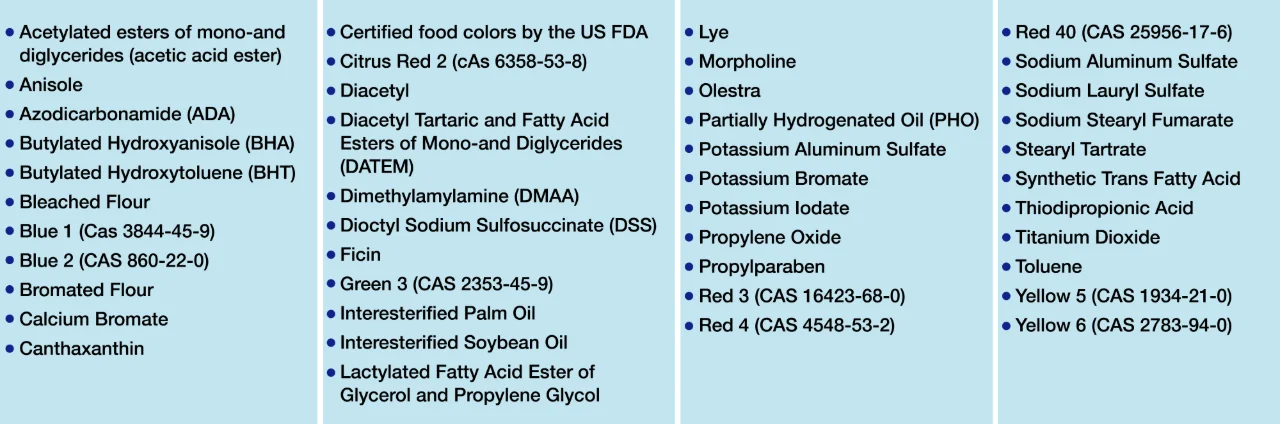
While some of the ingredients, dyes, and additives may be unfamiliar, they have been used in processed foods and snacks in the United States for decades. However, they are banned by some of our closest allies on the international stage. The use of these ingredients, along with the prevalence of ultra-processed foods in American communities, has been linked to chronic health conditions across the United States.
A number of the ingredients, including Red 40, are also under fire on the federal level, with Health Secretary Robert F. Kennedy Jr. directing the FDA to remove eight petroleum-based artificial food dyes from the US food supply (including Red 40) in early 2025.
Additionally, West Virginia passed a bill banning seven dyes from food items and school lunches in March 2025.
National and Worldwide Impacts
Because Texas has the second-largest economy in the United States (by GDP) and the eighth-largest in the world, SB 25 is set to have ripple effects across global food supply chains and labeling practices. Creating Texas-specific products would likely be costly and operationally complex, prompting many food manufacturers to reformulate ingredients across multiple markets.
A similar outcome followed California’s implementation of Proposition 65, the Safe Drinking Water and Toxic Enforcement Act of 1986.
Although the act applies only to products sold in California, the state’s position as the nation's largest economy and the world’s fourth-largest economy has prompted producers and manufacturers around the world to reformulate their products rather than create “California-specific” offerings, reducing costs and simplifying operations.
This sentiment is supported by findings from a study conducted by the Silent Spring Institute and the University of California, Berkley, which found the following:
78% of respondents claimed Prop 65 catalyzed businesses to reformulate products
81% of respondents claimed Prop 65 was a guide for which chemicals to steer clear of when sourcing raw materials and creating new products
63% of manufacturers claimed Prop 65 drove them to reformulate products sold outside of California
Drawing on the national and global effects of Prop 65, The Packaging School projects that SB 25 will have similar impacts on food manufactures and CPGs brands worldwide.
Although the law passed in June 2025, a number of major food manufacturers in the US—including Kraft Heinz and PepsiCo—have already committed to removing artificial colorings and additives and transitioning to natural ingredients. This push likely comes from a mix of pressure from Texas’ SB 25 and Robert F Kennedy Jr.’s commitment to remove artificial and synthetic food dyes from the US food supply. Texas’ SB 25 is heavily aligned with these plans and requires brands to take action or include a label that is likely to turn away many consumers.
Packaging-Related Ripple Effects to Anticipate . . .
As we highlighted, SB 25 will not only have ripple effects on R&D and food production teams, but also on packaging and labeling departments and suppliers.
SB 25’s packaging and labeling-related changes are robust and may require manufacturers to redesign labels and packaging to reflect new ingredients or add warning labels in cases where manufacturers are unable to remove one of the 44 additives covered by the law.
Three key packaging and labeling-related changes and opportunities include:
1. Comprehensive packaging and labeling redesigns to educate consumers on new ingredients and natural additives
This serves as a value-position for brands in markets outside of Texas and around the world. These changes will also help maintain compliance and speak to consumers in markets in the EU, Canada, UK, and other markets that inspired SB 25.
In anticipation of other SB 25-related laws across the country, it would be smart to invest in a scalable solution to update and place information on pack, leveraging ways to digitize and or use technologies.
2. Navigating the warning label requirements laid out in SB 25 and ensuring it does not clash with overall packaging and labeling design where additives cannot be removed from products
As a result, brands may need to provide consumers with additional context about the warning label. They may opt to use QR codes that direct consumers to more detailed information, including the company’s own safety testing done and scientific rationale for using certain ingredients, despite the warning requirements given by SB 25.
It is also possible brands will link landing pages outlining their plans to transition away from additives covered by SB 25, along with plans to adopt natural alternatives recognized as safe by Texas lawmakers and the international community.
As highlighted above, the Warning label must: be in a font similar to other essential consumer information, be placed in a “prominent and reasonably visible location,” and have high contrast with background to ensure the label is visible to the average consumer. Aside from these mandatory elements, packaging design teams will need to be creative to maintain consumer trust despite the label.
3. Staying up to date with changes to SB 25 and potential expansion of additives that warrant the label
With fines up to $50,000 USD per day per product in violation and new findings on the risks of synthetic additives and dyes, packaging and compliance teams will need to be diligent to stay ahead of the curve.
Last-minute packaging and labeling changes are costly and can cause supply chain hiccups—brands who proactively remove ingredients and design new labels will avoid these complications. Developing a scalable process for implementing new labels across SKUs will be essential as SB 25 takes effect in early 2027 and compliance requirements continue to evolve.
As with EPR regulations, food safety and additive requirements are evolving quickly in both the US and around the world. With the current administration’s MAHA initiative, that pace is likely to accelerate. Brands that work with packaging and labeling suppliers will need to take the lead in communicating regulatory updates and required changes to these stakeholders, requiring resources and comprehensive communication strategies.
These are just three of the changes brands can expect when it comes to SB 25 compliance; The Packaging School recommends developing a nimble and diverse team of packaging engineers, labeling specialists, regulatory gurus, and more to shift packaging and labeling as needed to stay compliant and educate uneasy consumers.
Resources to Help Your Team Prepare for SB 25
If you’re looking for resources to help navigate SB 25 compliance and the resulting label and packaging redesigns, The Packaging School offers a range of online programs designed to help professionals effectively lead packaging redesign projects.
Our Certificate of Mastery in Packaging Management program has a Packaging Development Plan (PDP) that guides you through the packaging management and development process. Check out an alumni project here: Garrett Patrick of the Gorilla Glue Company.
Interested in redesigning your packaging and labeling to comply with SB 25 requirements through our PDP and CMPM program? Email the program director, Dr. Julie Rice Suggs, at julie@packagingschool.com to learn more.
February 2026 Update:
According to Covington, in February 2026, a federal district court in Texas restricted the Texas Attorney General (Ken Paxton) from enacting and enforcing Section 9 of SB 25—the section requiring the warning label for human food products containing any of the 44 ingredients. The court granted the motion for a preliminary injunction. The initial lawsuit was filed by the American Beverage Association, Consumer Brands Association, the National Confectioners Association, and FMI (the Food Industry Association) and claims the section is unconstitutional and violates the first amendment. Until a final ruling is made, the manufacturers of covered products will not be legally required to include the label.
The Packaging School team will work to update this article as new information emerges.
By signing up you indicate you have read and agree to our Terms of Use. Packaging School will always respect your privacy.
