
Michigan’s Bottle Bill Explained

Michigan | Bottle Deposit Law
Michigan introduced its bottle bill, the Bottle Deposit Law, in 1976. Like other bottle bills in the United States, the Bottle Deposit Law has undergone a number of changes since its launch in the 1970s—see the full change history here.
Some Michigan legislators and environmental groups have proposed creating a dedicated hotline to report instances of bottle bill fraud, such as retailers selling out-of-state containers.
What’s Included?
Michigan’s bottle bill covers and exempts the following beverages:
Beverages Covered: Soft drinks and soda water, carbonated natural and mineral water and nonalcoholic carbonated beverages, beer and other malt beverages, mixed wine and spirit drinks, and kombucha.
Containers Covered: Glass, paper, plastic, and metal containers that are less than 1 gallon.
Exemptions: Not clearly specified, but wine, dairy and milk products, plant-based milk beverages, and others are not included in the covered beverages.
What’s the Refund Value?
The refund value for all covered containers under Michigan’s bottle bill is 10 cents.
Impact of DRS in Michigan
When compared with other states with bottle bills, Michigan’s PET, aluminum, and glass recycling rates are relatively average. However, all three are comfortably above the national averages.
PET recycling rate (2018): 29% (9.96 percentage points above the national average 19.04%)
Aluminum recycling rate (2018): 76% (44.72 percentage points above the national average of 31.28%)
Glass recycling rate (2018): 54% (28.14 percentage points above the national average of 25.86%)
[Data from 50 States of Recycling 2.0 by Ball Corporation & Eunomia.]
A TOMRA study highlights that Michigan's bottle bill redemption rate was 73% in 2023—the third highest among the 10 US states with bottle bills based on 2023–2024 return rates.
2026 Update
An August 2026 report by the Container Recycling Institute (CRI) includes data on DRS redemption rates by state, including Michigan’s bottle bill redemption rates from 2013 to 2025.
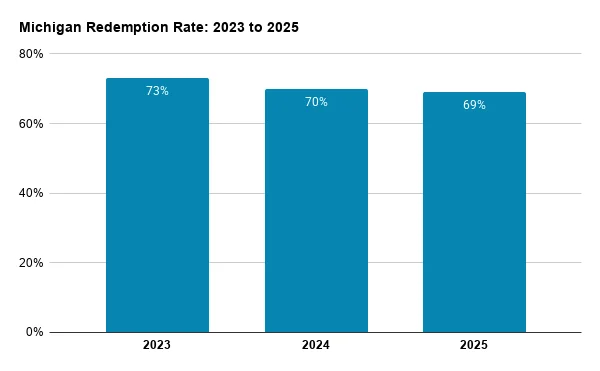
Michigan’s DRS redemption rate for 2025 was 69%, down 1 percentage point from 2024 and down 4 percentage points from 2023. This trend is similar to the relatively small fluctuations seen in many other DRS states (aside from Connecticut), which experienced redemption rate increases or decreases of 1–3 percentage points from 2023 to 2025.
The chart below shows changes in Michigan’s redemption rate from 2023 to 2025:
A broader look at Michigan’s redemption rates from 2013 to 2025 is shown below:
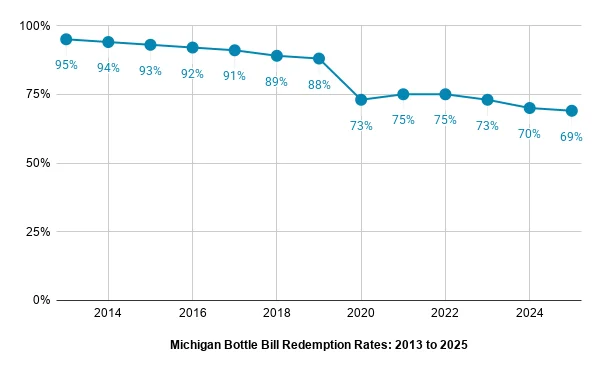
As the chart illustrates, Michigan’s DRS redemption rate has trended downward since 2013, with the 2025 rate 26 percentage points below its 2013 high. The most significant decline occurred at the start of COVID-19 pandemic, with a 15-percentage-point drop from 2019 to 2020.
Time will tell if Michigan can revitalize its bottle bill to restore pre-COVID redemption rates, perhaps looking to Connecitcut’s 2021 modernization bill for inspiration.
Learn more about Michigan’s Bottle Deposit Law here.
Read about the bottle bills in the nine other US states here.
By signing up you indicate you have read and agree to our Terms of Use. Packaging School will always respect your privacy.
