
Connecticut's Bottle Bill Explained

Connecticut | Beverage Container Deposit & Redemption Law
The state of Connecticut introduced a bottle bill in April 1978 with its Beverage Container Deposit & Redemption Law.
In June 2021, Governor Lamont signed SB 1037 into state law, expanding the scope of containers collected and increasing the refund value from 5 cents to 10 cents to boost consumer participation and keep up with inflation.
According to Waste Dive, SB 1037 is the "most significant" update to Connecticut's bottle bill since its implementation in 1978. See the "Impact of DRS in Connecticut" and “2026 Updates” sections below to explore the impact of SB 1037 and how it can serve as a model for future bottle bill updates across the country.
What's Included?
An updated list from August 2022 lays out the beverages and containers covered by the bill, as well as what is exempt:
Beverages Covered: Beer and malt beverages, soda, carbonated mineral water, malt-based hard seltzer and cider, water, sports drinks, energy drinks, juice, juice drinks, tea and coffee, kombucha, and plant-infused drinks
Containers Covered: Individual glass, metal, or plastic bottles, cans, jars, and cartons, etc.
Exemptions:
Hard cider products—effective July 1, 2025
Containers smaller than 150 mL
Carbonated drinks in containers larger than 3 L
Non-carbonated beverages in containers that are larger than 2.5 L
Wine and spirits and cocktails (wine- and spirits-based)
Milk and dairy products
Plant-based milks
Mixers
Medical electrolyte drinks (e.g., Pedialyte)
Meal replacement drinks and protein shakes
THC-infused beverages
Beverages in paper cartons and pouches
What's the Refund Value?
As mentioned above, SB 1037, effective January 2024, increased the redemption value from 5 cents to 10 cents for all covered products—an effort to increase engagement among consumers and other stakeholders.
Impact of DRS in Connecticut
Like New York and Iowa, Connecticut has average recycling rates compared with other states with DRSs, but its rates are above the national average:
PET recycling rate (2018): 45% (25.96 percentage points above the national average of 19.04%)
Aluminum recycling rate (2018): 47% (15.72 percentage points above the national average of 31.28%)
Glass recycling rate (2018): 45% (19.14% percentage points above the national average of 25.86%)
[Data from 50 States of Recycling 2.0 by Ball Corporation & Eunomia.]
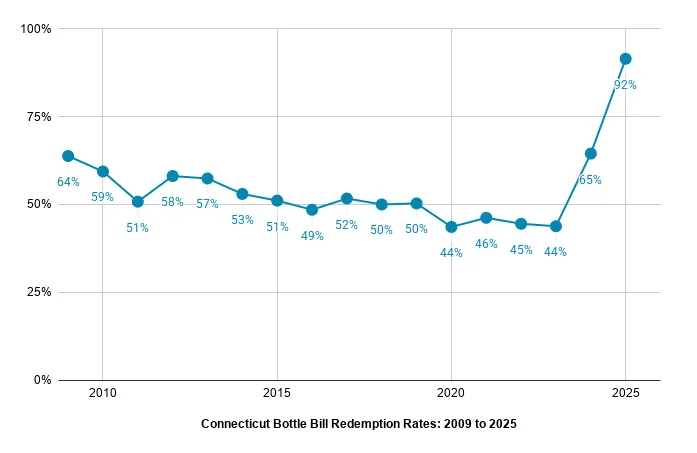
A key impact of SB 1037 implementation (effective January 2024) was an increase in the beverage container redemption rate from 44% in 2023 to 65% in 2024—a 21-percentage-point increase year over year.
During the same period, many other states saw redemption rates fall by 1–3 percentage points, while New York's rate increased by 1 percentage point and rates in California and Oregon remained unchanged. (Waste Dive + Container Recycling Institute).
Connecticut's Department of Energy & Environmental Protection highlights that in Q1 2025, the program was responsible for redeeming more than 360.9 million containers, with a quarterly redemption rate of 84.7%—up from 51.9% in Q1 2024.
Using the same TOMRA data we used for other states, Connecticut's DRS redemption rate in 2024 was 65%—the sixth-highest rate among states with DRSs in 2023–2024.
2026 Update
A report from the Container Recycling Institute (CRI)—a leading recycling research institute—released in early August 2026 provides data on Connecticut’s total bottle bill redemption rate for 2025.
In 2025, the redemption rate for Connecticut's DRS across all covered materials and container types was 92%—up 27 percentage points from 2024 and 48 percentage points from 2023. This growth is largely attributed to the impacts of SB 1037.
The chart below shows changes in Connecticut’s redemption rate from 2023 to 2025:
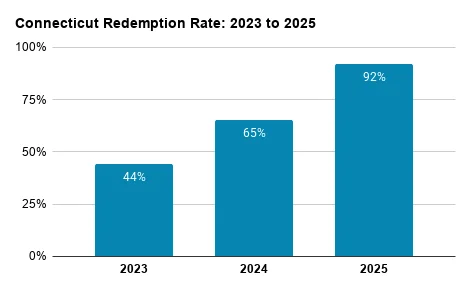
Compared with neighboring DRS states like Massachusetts and New York, Connecticut’s redemption growth rate from 2023 to 2025 is certainly an outlier. Waste Dive and CRI attribute this dramatic growth to the changes introduced by SB 1037, including doubling the refund value from 5 cents to 10 cents and expanding redemption access—creating greater incentives and convenience for consumers to participate.
Connecticut’s success story—and the impact of SB 1037—is even more telling when you look at redemption rates from 2009 to 2025:
Stay up to date with Connecticut’s Beverage Container Deposit & Redemption Law here.
Read about the bottle bills in the nine other US states here.
By signing up you indicate you have read and agree to our Terms of Use. Packaging School will always respect your privacy.
