
Maine’s Bottle Bill Explained

Maine | Returnable Beverage Container Law
The state of Maine introduced its Returnable Beverage Container Law in 1978, becoming the third state in the United States to introduce a bottle bill.
According to the Natural Resources Council of Maine (NRCM), Maine’s DRS has been the "most successful waste and litter reduction law" in the state’s history.
Maine's bottle bill is administered by the Maine Department of Environmental Protection and NRCM. Despite the program's success, NRCM notes that lobbying pressure, inflation, and labor shortages have threatened and continue to threaten the success of Maine’s bottle bill.
This led Maine Governor Janet Mills to sign An Act to Modernize Maine’s Beverage Container Redemption Law (LD 1909) in August of 2023. LD 1909 was designed to restructure funding so that unredeemed deposits could be used to improve the bottle bill, make sorting at redemption centers easier by allowing containers to be sorted by material instead of brand, and incentivize reuse and refill systems.
Packaging Dive reports that LD 1909 followed an “emergency bottle bill update” in May 2023 that increased handling fees from 4 cents to 6 cents per container (paid to retailers, redemption centers, etc. to help with operation costs of reverse logistics programs, machines, and staff). The increase came in response to 50 redemption centers closing in the state from 2020 to 2023.
What’s Included?
Beverages Covered: Beer, hard cider, wine coolers, soda, non-carbonated water beverages, alcoholic drinks, spirits, wine, and more.
Containers Covered: Glass, plastic, and metal containers that are 4 liters or less.
Exemptions:
Milk and dairy products
Apple cider and blueberry juice produced in Maine
Seafood, meat, and vegetable broth soups
Instant drink powders
Products designed to be "consumed in a frozen state"
Liquid syrups, concentrates, extracts, etc.
Products sold in cartons and other formats not listed in the "Containers Covered" section
What’s the Refund Value?
Similar to California’s AB 2020, Maine’s DRS has a tiered refund value:
Beer, hard cider, wine coolers, soda, non-carbonated water beverages, alcoholic drinks, etc.: 5 cents
Wine and spirits: 15 cents
Impact of DRS in Maine
Maine has a long history of implementing environmental legislation, including DRS and extended producer responsibility (EPR). According to the data source used throughout this series, Maine had the highest PET, aluminum, and glass recycling rates in the nation in 2018:
PET recycling rate (2018): 75% (highest in nation)
Aluminum recycling rate (2018): 83% (highest in nation)
Glass recycling rate (2018): 76% (highest in nation)
[Data from 50 States of Recycling 2.0 by Ball Corporation & Eunomia]
Maine: A National Leader in Recycling
Maine’s recycling rates are impressive and well above the national averages—they’re even high compared with other states with DRSs:
PET recycling rate (2018): 75% (55.96 percentage points above the national average of 19.04% and 28.2 percentage points above the average of the 10 states with DRSs (46.80%))
Aluminum recycling rate (2018): 83% (51.72 percentage points above the national average of 31.28% and 15.4 percentage points above the average of the 10 states with DRSs (67.60%))
Glass recycling rate (2018): 76% (50.14 percentage points above the national average of 25.86% and 22.2 percentage points above the average of the 10 states with DRSs (53.80%))
Additionally, the Natural Resources Council of Maine (NRCM) calls the bottle bill the "most successful waste and litter reduction law" in the state's history.
NRCM also states that the program helps recycle more than 40,000 tons of material each year. In 2021, approximately 25% of bottles purchased in the state were not returned, with 1.17 billion containers sold. This means that approximately 877.5 million containers were returned through the program in 2021.
Referencing the same TOMRA data used for the other states, Maine's bottle bill had a 77% redemption rate in 2023—the second highest among the 10 US states with bottle bills based on 2023–2024 return rates, behind Oregon at 87% in 2023.
2026 Update
A new report from the Container Recycling Institute (CRI) covers US DRS redemption rates by state, including Maine’s bottle bill redemption rates from 2020 to 2025.
Maine’s DRS redemption rate in 2025 was 69%, down 5 percentage points from 2024 and 8 percentage points from 2023. This decline is slightly different from the relatively small fluctuations seen in many other DRS states (aside from Connecticut), which experienced redemption rate increases or decreases of 1–3 percentage points from 2023 to 2025.
The chart below shows changes in Maine’s redemption rate from 2023 to 2025:
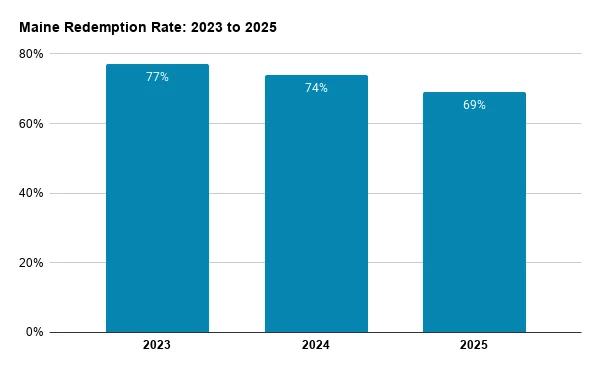
Maine’s 2025 DRS redemption rate being 8 percentage points lower than in 2023 is certainly something for system administrators to monitor. Maine’s decline from 2023 to 2025 is the most substantial among the 10 DRSs analyzed.
However, CRI data from 2020 to 2025 show that Maine’s redemption rate remained relatively stable from 2020 to 2024:
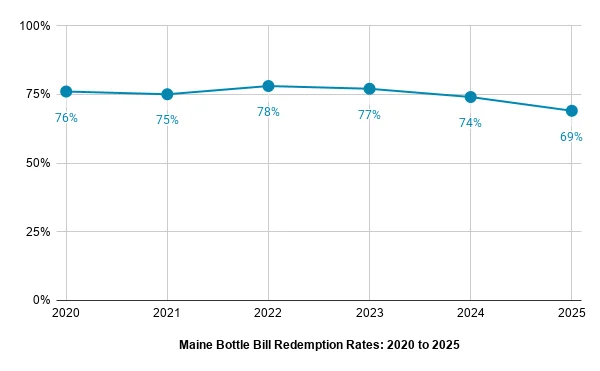
With the implementation timeline for Maine’s extended producer responsibility (EPR) for packaging program now uncertain following recent news that no stewardship organization responded to the Maine Department of Environment Protection’s request for proposals, perhaps legislators will focus on further modernizing the state’s bottle bill in the meantime.
Regardless, data shows that Maine is already a leader in recycling. Further modernization of its bottle bill could help cement this position moving forward.
Read more about Maine’s DRS and efforts to uphold its success despite macroeconomic shifts and industry pressure here.
Read about the bottle bills in the nine other US states here.
By signing up you indicate you have read and agree to our Terms of Use. Packaging School will always respect your privacy.
