
Exploring California's Bottle Bill

California | Beverage Container Recycling & Litter Reduction Act (AB 2020)
Fifteen years after Oregon passed its bottle bill, California passed the Beverage Container Recycling and Litter Reduction Act (AB 2020), making it the ninth US state to implement a DRS.
Similar to California's extended producer responsibility (EPR) for packaging program (SB 54), AB 2020 is managed by CalRecycle.
Like Oregon’s bottle bill, AB 2020 has undergone a number of amendments, including the expansion of covered beverages in 2000, and increases to deposit rates in 2004 and 2007. The full history of AB 2020 is available here.
What’s Included?
Beverages Covered: Beer and malt beverages, wine coolers and distilled spirits, all nonalcoholic beverages (except milk), and wine and spirits.
Containers Covered: Aluminum, glass, plastic, and bimetal containers.
Exemptions:
Milk products
Beverages sold in refillable containers
Beverages sold in containers other than those listed in the "Containers Covered" section (including paper cartons)
What’s the Refund Value?
California’s AB 2020 has different refund values based on container size, unlike Oregon’s program, which has a 10-cent refund value for all covered containers. California’s breakdown includes:
Containers 24 oz or larger: 10 cents
Containers smaller than 24 oz: 5 cents
As of January 1, 2024: Boxes and bladders / pouches containing wine, distilled spirits, wine coolers, and distilled spirit coolers have a 25-cent refund value.
Impact of DRS in California
California’s 2018 recycling rates for PET, aluminum, and glass highlight the state’s strong recycling performance after decades with a DRS.
PET recycling rate (2018): 56% (third highest in country, behind Maine and Oregon)
Aluminum recycling rate (2018): 77% (third highest in country, behind Maine and Oregon)
Glass recycling rate (2018): 49% (eighth highest in the country)
[Data from 50 States of Recycling 2.0 by Ball Corporation & Eunomia.]
CalRecycle highlights that in 2023 alone, Californians recycled 18.8 billion containers—more than 400 containers per person.
Since the bill was passed in 1986, the program has helped facilitate the recycling of 482 billion bottles and cans. CalRecycle also reports that more than 80% of beverages sold in the state are covered by the program.
Furthermore, in a 2022 report on beverage container recycling in California, the recycling rate for covered materials was 70%—calculated by dividing the number of beverage containers returned (19.6 billion) by the number of containers sold into California (27.8 billion).
This rate was up 2 percentage points from 68% in 2021, with a program goal of 80%.
The same report also breaks down the recycling rates by container type, with aluminum, PET, and PP reporting some of the highest rates in 2022 with 74%, 70%, and 76%, respectively.
The Packaging School highly recommends diving into the report to learn more about DRS in the nation's largest economy (and the fourth-largest economy in the world!) and how states measure and report the impact of their DRSs.
2026 Update
A report from the Container Recycling Institute (CRI)—a leading recycling research institute— released in early August 2026 provides data on California’s bottle bill redemption rate for 2025.
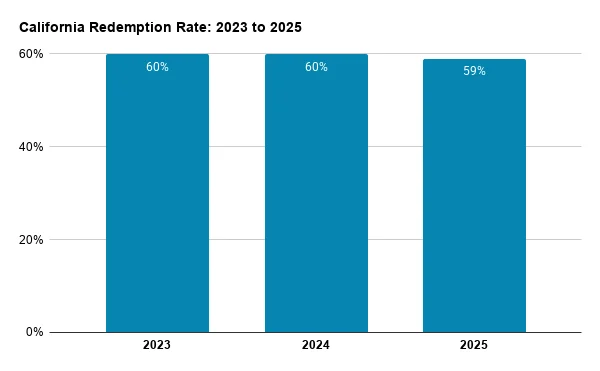
In 2025, the redemption rate for California’s DRS was 59%—down 1 percentage point from 2024.
The chart below shows minor fluctuations in California’s redemption rate from 2023 to 2025:
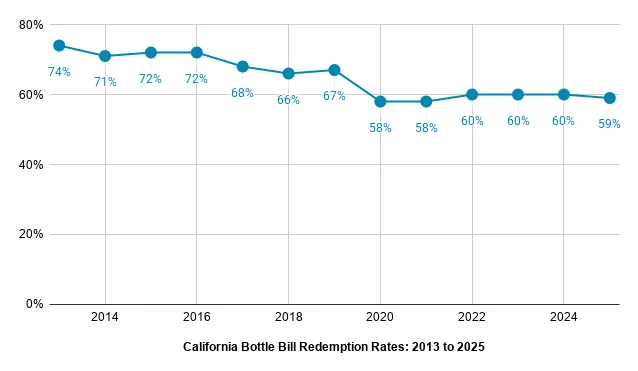
Taking a wider look at redemption rates, CRI data from 2013 to 2025 indicate that California’s redemption rate has generally declined since 2013, with the 2025 rate 15 percentage points lower than in 2013.
Learn more about California’s Beverage Container Recycling and Litter Reduction Act here.
Read about the bottle bills in the nine other US states here.
By signing up you indicate you have read and agree to our Terms of Use. Packaging School will always respect your privacy.
