
The Impact of Sustainability Education
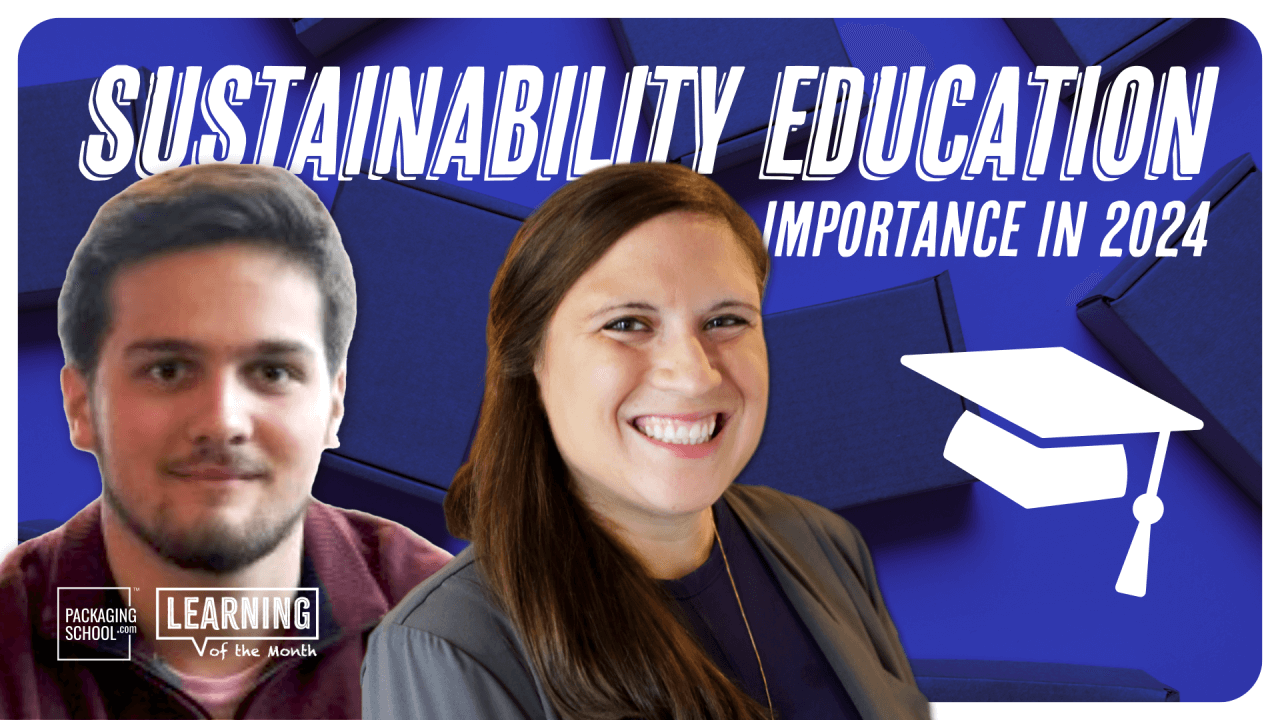
Julie: Hey Mitch, welcome to this interview—so great to have you here!
Mitch: Thank you so much for having me. Thanks for the opportunity to be able to talk a little bit about my story, my role here, and my thoughts on some of these sustainable packaging trends.
Julie: Awesome. Well, let's dive right in. So first off, tell me a little bit about your role as the business strategist here at the Packaging School.
Mitch: Sure, the term business strategist, I like to think of it as mainly the omnichannel marketing lead, but also focusing on some other areas like market research, particularly international markets, also looking at content management and strategy for our array of marketing channels, and also using the expertise I got in my master's program to help aid in the development and some of the go-to-market strategies for some of our sustainability related offerings.
Julie: I know you have a Master's of Science in Sustainability Management from American University. Can you tell us some of your main takeaways from this program?
Mitch: I'd like to think of it as similar to a traditional MBA where you look at the different functional areas of business, but also looking at everything through the lens of environmental and social sustainability. I would like to say sustainability is not a one-time conversation organization. It must be approached from the start and continuously monitored and revisited with processes involving all stakeholders in this process.
And you want to view sustainability as a two-sided coin. One is the risk management side in avoiding legal risks, reputational risks. But a lot of times we don't think about the other side of the coin which is the upside, the differentiation, developing that competitive advantage, increasing efficiencies, and reducing costs across your organization. So, viewing it in a number of ways.
Another key takeaway is—everything starts with materiality. And a lot of times this is approached through starting with the materiality assessment when you're
launching your sustainability journey. This can be done in-house with engaging all the stakeholders, the relevant stakeholders in your organization. It can also be done through engagement with a third party, which a lot of companies do, but a lot of times they'll do it in-house and sometimes consult these overarching frameworks—one from the Global Reporting Initiative, also known as GRI. They have a materiality assessment framework, which a lot of companies use just to get the wheels spinning.
One more key takeaway—there's so many I could go on about—would be that it's an evershifting landscape. It was really cool to get a master's in a nascent industry. Sustainability management is still relatively new compared to other professions. And the shifting landscape was ever so present in my reporting class as new frameworks would pop up week on week. We got to learn about ones that were established, like SASB (Sustainability Accounting Standards Board) and TCFD (The Taskforce on Climate-related Financial Disclosures), but emerging ones like CSRD (Corporate Sustainability Reporting Directive) and TNFD (The Taskforce on Nature-Related Financial Disclosures) just constantly made the landscape ever so confusing. Companies need to find a way to find out what audience they want to speak to and looking at everything through this lens of materiality to gauge where time and resources should be spent.
Julie: What do you feel are the most pressing challenges in sustainability today—sustainable packaging today?
Mitch: Yeah, it's a great question. I could talk for a long time about some of the challenges I see in sustainability management and corporate sustainability as a whole. I'll focus on some of the ones identified in packaging for this convo.
One of the main things I see is cutting through the jargon or some of the preconceived notions folks have about one material over the other when it's not soundly based in research or in LCA. A lot of times folks are painting one material as more sustainable than the other, but not doing the due diligence to actually compare the systems. And we need to think larger about these issues—if a material might be seen as more sustainable by the public, but it improves shelf life or it's lighter and improves the ability to ship more materials in one load—there's just multiple ways to think about it. We should try to approach it by being material agnostic and then let the data drive us.
Another challenge I see in sustainability in packaging is avoiding this concept of carbon tunnel vision. For those who don't know, it is when a lot of folks approach the concept of sustainability, they have this myopic focus on carbon CO2 emissions reductions, which is a big part of the puzzle and something that we need to be reducing. But, it's just a tiny piece of the sustainability puzzle. You have to think of—just think of a packaging system's impact on the environment. It goes far beyond carbon intensity. It can have impacts on water quality, water intensity, eutrophication, biodiversity loss, end of life and pollution to terrestrial and aquatic ecosystems. So, just focusing only on carbon, again, can hurt you in that risk management side where you say, “Oh, we're not focusing on some other key topics.” But also, it misses a chance to innovate and differentiate your brand by creating cool innovations in the areas of like water intensity or something. So just focusing on carbon is something a lot of the industry does, and it makes sense because carbon and GHG gas issues have been around for a little longer and people have been talking about them and there's more frameworks to measure them. And it's a big topic of conversation. But as I said, it's a tiny piece of the sustainability puzzle. And I think people are overlooking that sometimes.
Julie: You've done a great job at the packaging school to incorporate the UN Sustainability Development Goals or SDGs into our curriculum. So basically, how do you think companies in the packaging industry can use these goals to shape and steer and communicate to be able to report these strategies and goals and activities in their everyday workforce?
Mitch: I see the SDGs as a launching pad for your sustainability journey, similar to materiality assessment. If you're new to thinking about sustainability and you want to think about, “Where does our organization, where do we have an impact on these lofty world goals?”—if you're not familiar with the SDGs, it's 17 goals set forth by the UN that are targets in mind for 2030 and they're more for industries at large for private and public sectors—so if you want to think about, “Where does our organization have an impact?” that's usually a good place to start. I also would recommend diving in further to each of the SDGs because they might seem lofty. SDG 12 is Responsible Consumption and Production, and you might be thinking, “What does that mean?” But if you dive into the targets and indicators, they'll have many under each. So 12.2 is one in SDG 12. A lot of times companies will say they align with SDG 12, but further in a report, will align with a particular sub-target that's a little more time bound and specific than just the overarching SDG. So if you haven't explored that with the SDGs, I highly recommend it. You can look at it through the website and then, each SDG, you'll click on it, and it has targets and indicators.
Julie: How do you feel that education can help spur this meaningful change?
Mitch: Absolutely. Education, I think, is one of the critical keys in this process, and this is one of the reasons I love my role here and love working here, is that we're making a tangible impact and we're helping create internal changemakers in organizations and pushing the industry forward through our training and programs.
Education is huge. Our online format makes it easy for ways in which we can engage people who are already in companies and might have great packaging knowledge or packaging engineering knowledge, but giving them that sustainability thought can help push their organization forward. So for me, I see education as one of the key components moving it forward, which makes the work we do here so exciting in my view.
By signing up you indicate you have read and agree to our Terms of Use. Packaging School will always respect your privacy.
