
Oregon’s Bottle Bill Explained

Oregon | The Bottle Bill (HB 1036)
The state of Oregon introduced the first deposit return scheme (DRS) in the United States with its Bottle Bill (HB 1036), passed in 1971. Over its more than 50-year history, Oregon’s bottle bill has undergone a number of amendments, including those passed in 2007 and 2011, both of which expanded the types of beverages covered under the DRS.
The Oregon Department of Environmental Quality (DEQ) notes that this bill was “one of the most intensely lobbied bills in the history of the Oregon Legislature.” This is still the case today with industry groups working to curb the development of bottle bills & EPR programs alike, as seen this year in Rhode Island and New York alone.
Oregon's HB 1036 is managed by the Oregon Liquor and Cannabis Commision—overseeing the program, the flow of the deposits, providing administrative support, and working to keep bottles and containers in the loop.
What’s Included?
Beverages Covered: According to a bottle bill FAQ, Oregon’s bottle bill covers the following beverages:
Water, carbonated and sparkling beverages, beer and malt beverages, kombucha, and hard seltzer in a package that is three liters or less.
Non-alcoholic beverages (tea, coffee, juice, etc.), other alcoholic beverages (hard cider, etc.), and marijuana and hemp beverages in a package that is four ounces up to 1.5 liters—see the full list here.
Containers Covered: sealed glass, metal, or plastic containers that are 3 liters or less—with requirements for different beverage types (listed above).
Exemptions:
Beverages in cartons, foil pouches, and drink bottles and metal containers that require a “tool to be opened.”
Distilled spirits, products where “Milk” of any kind is listed as first ingredient, infant formula, liquid meal replacements, concentrated beverages (like lemon concentrate), syrups / flavorings (grenadine, bitters, etc.), coffee creamers, non-beverage foods and condiments (olive oil, soy sauce, etc.), wine that is not in a can.
What's the Refund Value?
The refund value is ten cents USD for all containers larger than 24 oz. For containers 24 oz or smaller (denoted as "Small Containers"), the refund value is five cents USD.
To help consumers navigate which items are included in DRS, packages are denoted with OR 10¢ or OR 5¢.
Impact of DRS in Oregon
As the nation’s first state with a DRS program, Oregon has seen the benefits of the system, which is reflected in their 2018 recycling rates for PET, aluminum, and glass.
PET recycling rate (2018): 71% (second highest in the country behind Maine)
Aluminum recycling rate (2018): 82% (second highest in the country behind Maine)
Glass recycling rate (2018): 51% (seventh highest in the country)
[data from 50 States of Recycling 2.0 by Ball Corporation & Eunomia]
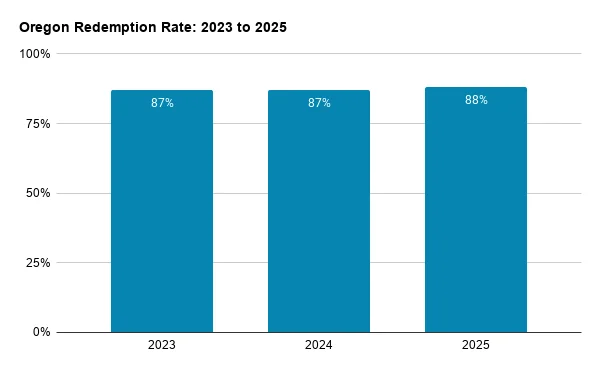
According to TOMRA, the redemption rate for Oregon's bottle bill was 87% in 2023—the highest of the 10 states with bottle bills in 2023 / 2024.
2026 Update
An August 2026 report from the Container Recycling Institute (CRI)—a leading packaging and recycling research institute—provides insight into Oregon’s total bottle bill redemption rate for 2025, allowing us to analyze the program’s success year over year.
In 2025, the total redemption rate for Oregon’s bottle bill was 88%, meaning that 88% of covered containers sold in Oregon were returned by consumers through reverse vending machines (RVMs) and other redemption centers.
The chart below shows the changes in the redemption rate from 2023 to 2025—marginal differences, but enough to maintain Oregon’s position as the second-most successful US bottle bill based on redemption rate:
Historical data from CRI allow us to visualize how redemption rates have changed since 2012:
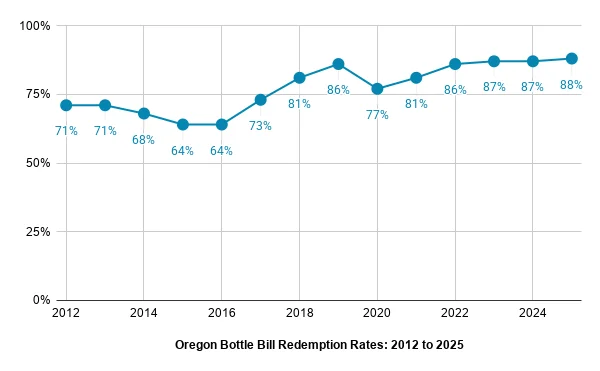
Data show that Oregon’s bottle bill has maintained consistent consumer participation and redemption success over the past decade. The 9% decline from 2019 to 2020 was likely driven by complications related to the COVID-19 pandemic, a trend seen across nearly all bottle bills in the US and around the world. Despite the dip, Oregon’s 2025 redemption rate has already surpassed its pre-COVID rate, ranking second highest in the country—just 4 percentage points below Connecticut.
Learn more about Oregon’s bottle bill here.
Read about the bottle bills in the nine other US states here.
By signing up you indicate you have read and agree to our Terms of Use. Packaging School will always respect your privacy.
