
How Evian and Burt's Bees Are Tackling Plastic Packaging Waste
Plastic, regardless of polymer type, is arguably the most scrutinized packaging material on the market today. Despite its shortcomings as a material, it is important to remember that every packaging material involves environmental and performance trade-offs. There is no “silver bullet" for truly sustainable packaging.
Additionally, some conventional plastics remain unavoidable in packaging systems, particularly in food, beverage, and medical applications where they are essential for shelf-life and product safety. In these cases, brands and packaging producers are finding innovative ways to cut the environmental impacts of plastic packaging systems—as demonstrated by Evian and Burt’s Bees.
In this article—part of our wider Packaging Innovation Dashboard series—we explore how Evian and Burt’s Bees take two radically different approaches to cut plastic packaging waste. Their stories reinforce the idea that some plastic innovations happen in internal R&D labs, while others require external partnerships.
Evian | Label-Free & 100% rPET Bottle Pilot Program
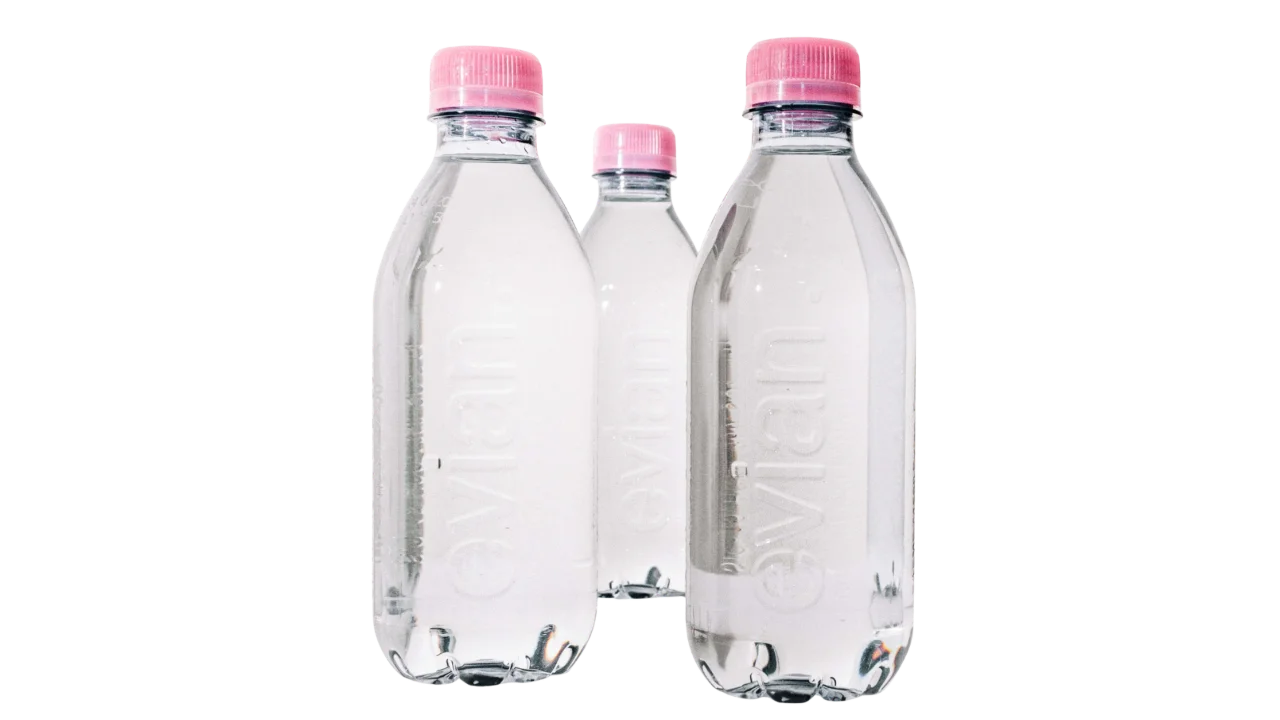
Photo from Evian
In July 2020, Evian launched a pilot of a 400 mL label-free bottle made from 100% recycled PET (rPET), excluding the cap, in select hotels and restaurants in France.
Instead of pursuing lightweighting or external partnerships, Evian went bold and removed the label entirely—increasing the recyclability of the bottle by shifting it from multi-material to primarily mono-material (excluding the cap).
The design also aligns with Evian’s brand identity. As the company explains, “The stripped back design perfectly reflects the purity of our water; uniquely sourced natural mineral water is the way nature intended, pure and refreshing.”
Beyond reinforcing the brand's identity, the pilot advanced Evian's—and parent company Danone's—ambition to become a fully circular brand by 2025. A video explains how the bottle was developed in Evian’s Innovation Lab and consisted of more than 20 different versions before arriving at the final design.
In addition to the sustainability and recycling benefits, the new bottle also offers significant shelf appeal. Its label-free design helps differentiate it within the planogram, where it is likely one of the few label-free water bottles available.
As of August 2026, our team verified that Evian’s label-free bottles expanded into specialty markets (hotels, airport lounges, etc.) in France (pilot), United Arab Emirates, Mexico, Malaysia, Philippines, Vietnam, and Singapore, based on Evian press releases published from September 2020 onward.
Our team also revisited Evian’s goal of becoming a “fully circular brand” by 2025, first announced in January 2018. As of August 2026, we were unable to verify whether the company achieved this milestone. However, Evian’s Climate Journey page reports that 87% of its bottles were made from recycled PET (rPET) as of year-to-date (YTD) September 2025 (excluding caps and labels), indicating the company did not reach its 100% rPET target across its bottle portfolio.
Read more here.
Burt’s Bees | Plastic Recovery with rePurpose Global
While some brands pursue packaging redesigns and lightweighting to meet their plastic sustainability goals, others, like Burt’s Bees, rely on cross-functional partnerships to achieve them.
In June of 2022, Burt’s Bees launched a partnership with rePurpose Global—a leading plastic action and collection organization—to fund on-the-ground projects in India and Ghana that help eliminate and collect ocean-bound plastic. rePurpose Global notes that the partnership was set to eliminate 1.5 million pounds of ocean-bound plastic by the end of 2024 and will eliminate 1.5 million pounds per year in 2025 and onward. Our team was unable to verify if these goals were accomplished in 2024 or 2025, but for more information on the partnership's impact, reach out to rePurpose Global here.
The program is part of Burt’s Bees’ goal to have “net zero plastic ending up in nature” by 2025. The partnership with rePurpose Global is one part of a multi-tiered plastic strategy. Additional goals include reducing the use of virgin packaging materials (both plastic and fiber-based) by 50% by 2030 and achieving 100% recyclable, reusable or compostable packaging by 2025.
Matt Kopac—former Associate Director of Sustainability at Burt’s Bees—was quoted in a rePurpose Global press release saying:
“Plastic waste is a huge challenge for our industry and the planet, and it demands true collaboration to tackle it. Not only does this partnership stop plastic from leaking into the ocean, but it also creates crucial opportunities to economically empower waste workers and their communities. We are very proud to join forces with rePurpose Global and support their thoughtful approach to tackling plastic pollution."
This partnership is a reminder that positive impact can occur far beyond the R&D lab. Sometimes, organizations need to join forces to reduce the impacts of plastic packaging litter on terrestrial and aquatic ecosystems.
Our team was not able to verify if the 2025 goals above were achieved—reach out to Burt’s Bees or explore the 2020 Impact Report (latest sustainability report) to learn more.
This model is also similar to the role of carbon markets in net zero emissions goals. Organizations can do everything possible to reduce their use of plastic packaging, but some plastics remain essential because of functional requirements and the limited availability of viable alternatives. In these cases, companies can partner with organizations like rePurpose Global to help reduce plastic waste beyond their own value chains and contribute to broader sustainability goals.
Read more on how brands partner with rePurpose Global here.
Explore More Packaging Innovation Case Studies
Dive into additional case studies exploring how brands are optimizing packaging systems, pioneering new materials, and forming strategic partnerships to reduce waste and environmental impact. Learn more here.
By signing up you indicate you have read and agree to our Terms of Use. Packaging School will always respect your privacy.
