
Exploring Massachusetts's Bottle Bill

Massachusetts | Provision for Recycling of Beverage Containers
The state of Massachusetts introduced its bottle bill in 1983 with the Provisions for Recycling of Beverage Containers.
According to the Massachusetts Department of Environmental Protection, the bill was initially introduced to reduce litter and conserve natural resources in the state.
Similar to other bottle bills in the United States, Massachusetts’s bottle bill has undergone a handful of amendments since 1983, including in 2003 and 2010. See the full change history here.
What’s Included?
According to Mass.gov, the Massachusetts bottle bill covers and exempts the following:
Beverages Covered: Carbonated soft drinks and sodas, beer and malt beverages, and sparkling and mineral water.
Containers Covered: Sealable cans, jars, and bottles made of metal, plastic, glass, or a combination of materials that are less than 2 gallons.
Exemptions: Wine, dairy and milk products, natural fruit juices, non-carbonated drinks, and all alcoholic beverages other than beer. The legislation also excludes containers labeled as "biodegradables."
What’s the Refund Value?
The refund value for Massachusetts’s bottle bill is 5 cents for all covered containers.
Impact of DRS in Massachusetts
Similar to Hawaii and Vermont, Massachusetts’s PET, aluminum, and glass recycling rates are relatively average when compared with other states with bottle bills. However, all three are comfortably above the national averages.
PET recycling rate (2018): 31% (11.96 percentage points above the national average of 19.04%)
Aluminum recycling rate (2018): 74% (42.72 percentage points above the national average of 31.28%)
Glass recycling rate (2018): 57% (31.14 percentage points above the national average of 25.86%)
[Data from 50 States of Recycling 2.0 by Ball Corporation & Eunomia]
TOMRA data show that Massachusetts's bottle bill had a 36% redemption rate in 2023—the lowest among the 10 US states with bottle bills based on 2023–2024 return rates.
In an effort to increase redemption rates, Waste Dive reports that Massachusetts lawmakers proposed an update to the bottle bill—including increasing the refund value from 5 cents to 10 cents—as part of a larger climate-related bill. However, the proposal failed to pass before the legislative session concluded on July 31, 2024.
2026 Update
The Container Recycling Institute (CRI) recently reported data on DRS redemption rates by state, including Massachusetts’s bottle bill redemption rates from 2007 to 2025.
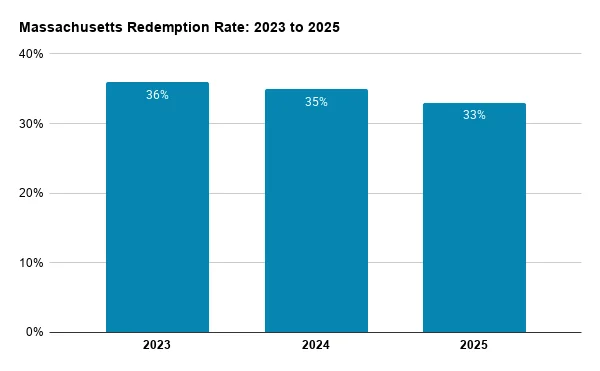
Massachusetts’s DRS redemption rate for 2025 was 33%, down 2 percentage points from 2024 and 3 percentage points from 2023. This trend mirrors the relatively small fluctuations seen in many other DRS states (aside from Connecticut), which experienced redemption rate increases or decreases of 1–3 percentage points from 2023 to 2025.
The chart below shows changes in Massachusetts’s redemption rate from 2023 to 2025:
While these fluctuations are relatively small, a broader look at Massachusetts’s redemption rates from 2007 to 2025 tells an entirely different—and less favorable—story:
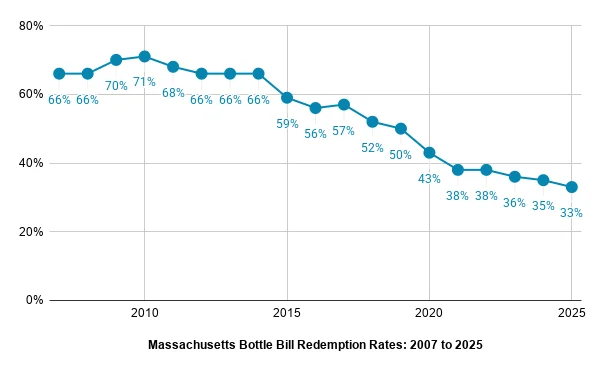
As the chart shows, Massachusetts’s DRS redemption rate is down 33 percentage points from 2007—the largest decline observed among the 10 DRSs in the United States. Like other states, Massachusetts experienced a significant decline during the COVID-19 pandemic. CRI expands upon this next to the 2020 data point, stating: "Redemption rate reflects the impact of reduced in-person redemption during the COVID pandemic."
Perhaps Massachusetts can learn from its neighbor to the south—Connecticut—on ways to modernize its bottle bill and bring redemption rates back to 2007 levels and beyond.
Read more about Massachusetts’s bottle bill here.
Read about the bottle bills in the nine other US states here.
By signing up you indicate you have read and agree to our Terms of Use. Packaging School will always respect your privacy.
